But first we're going to have to rebuild it. And these plastics definitely don't want to stay in one piece.
Showing posts with label linux. Show all posts
Saturday, August 1, 2026
MkLinux and the pimped-out Apple Workgroup Server 9150
As is typical here in the Floodgap lab, it all started so innocently: rebuilding a flaky Apple Workgroup Server 9150, the odd duck of the Workgroup Server line and older cousin to our beloved Apple Network Server. And then I just had to pimp it out for MkLinux.
Before the sui generis IBM AIX-based Apple Network Server, one of our favourite machines here at Floodgap, there were the WGSes, the Workgroup Servers, Apple's well-intentioned but conflictingly received line of Macintosh rebadges hopped up with high-spec options and special server software. While certain users had long repurposed desktop Macs as ad-hoc servers, these computers were the first Apple systems explicitly positioned and sold as such, and the first generation was even advertised with A/UX, Apple's own hybrid System V UNIX implementation.
A/UX ultimately didn't survive the 1994 68K transition to PowerPC, but in 1996 Apple publicly offered another option: run Linux, using the Mach microkernel. Although MkLinux emerged after the 9150's discontinuation, it's still just an overgrown NuBus Power Mac, so between more RAM, a beefier CPU upgrade and various video cards, by the end of this article we ought to have a configuration that gives us the best of two worlds — classic MacOS and MkLinux — in one server.
Saturday, June 27, 2026
Working around dragons with the Lemote Yeeloong laptop and OpenBSD
Behold: the Guru of GNU! (Photo by Habib Mhenni, Wikimedia Commons, CC BY-SA 3.0.)
True enlightment only comes from a truly free computing experience, probably! And while there is no nerd who lacks an opinion on Richard Stallman personally, likewise let none claim he does not practice what he preaches. Why, the very laptop in front of him was selected deliberately because it can operate with no binary blobs and no firmware you couldn't examine or replace with your own, and runs his choice of fully libre operating systems. The fact it has a Chinese MIPS64 derivative in it was undoubtedly just more compound on the heat spreader.
Now, in my case, the fact that it is a MIPS-family system meant I certainly needed one in my unusual laptop collection. And since it can run OpenBSD ...
... it seemed like a good way to get nerdsniped in two ways by one computer: since I mostly run NetBSD as my BSD and server operating system of choice, I figured this was also a good way to learn OpenBSD on a highly portable netbook using an unusual platform. As usual, of course, the whole shooting match turned out to be a much longer journey than I'd anticipated, and my typical insistence on deviating from the beaten path (such as forcing it to run from the SD card slot and trying to build a browser from source) made it more so. But before we embark upon it, let's talk about why there's a Chinese MIPS derivative in this thing in the first place.
Sunday, February 19, 2023
Dusting off Dreamcast Linux
Yes, here at Old VCR we live in the past, when RISC Unix workstations still ruled the earth like large boxy tentaculous Cthulhus. Oh, sure, if you wanted a modern equivalent you could just buy a Raptor POWER9 like the one I'm typing on now. But around here even PowerPC is too pedestrian of an architecture. We need something unique.
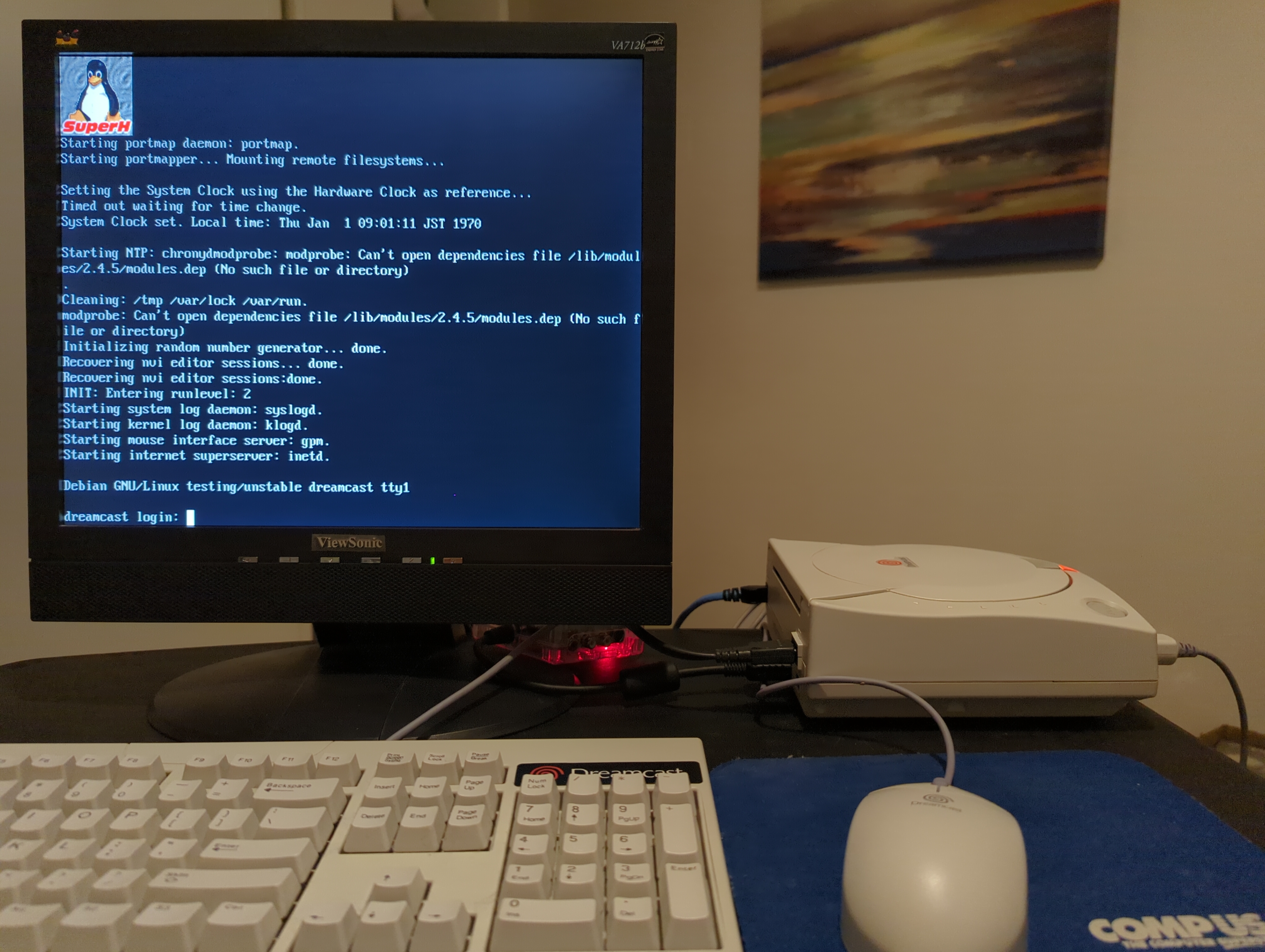
That's more like it! A keyboard, mouse, a NIC, VGA output, 16MB of RAM and a whole gig (you wish) of read-only optical drive space with a 200MHz Hitachi SuperH SH-4 CPU faulting its paltry 8K of I-cache and 16K of D-cache non-stop. Now freshly refurbished, its cooling fan runs louder than my Power Mac Quad G5 at idle and the drive makes more disk seeking noise than when I can't find a lost floppy. And since the buzzword with Linux distros today is immutability, what could be more immutable than an ephemeral, desperately undersized RAM disk overlaid on a live CD?
Subscribe to:
Posts (Atom)