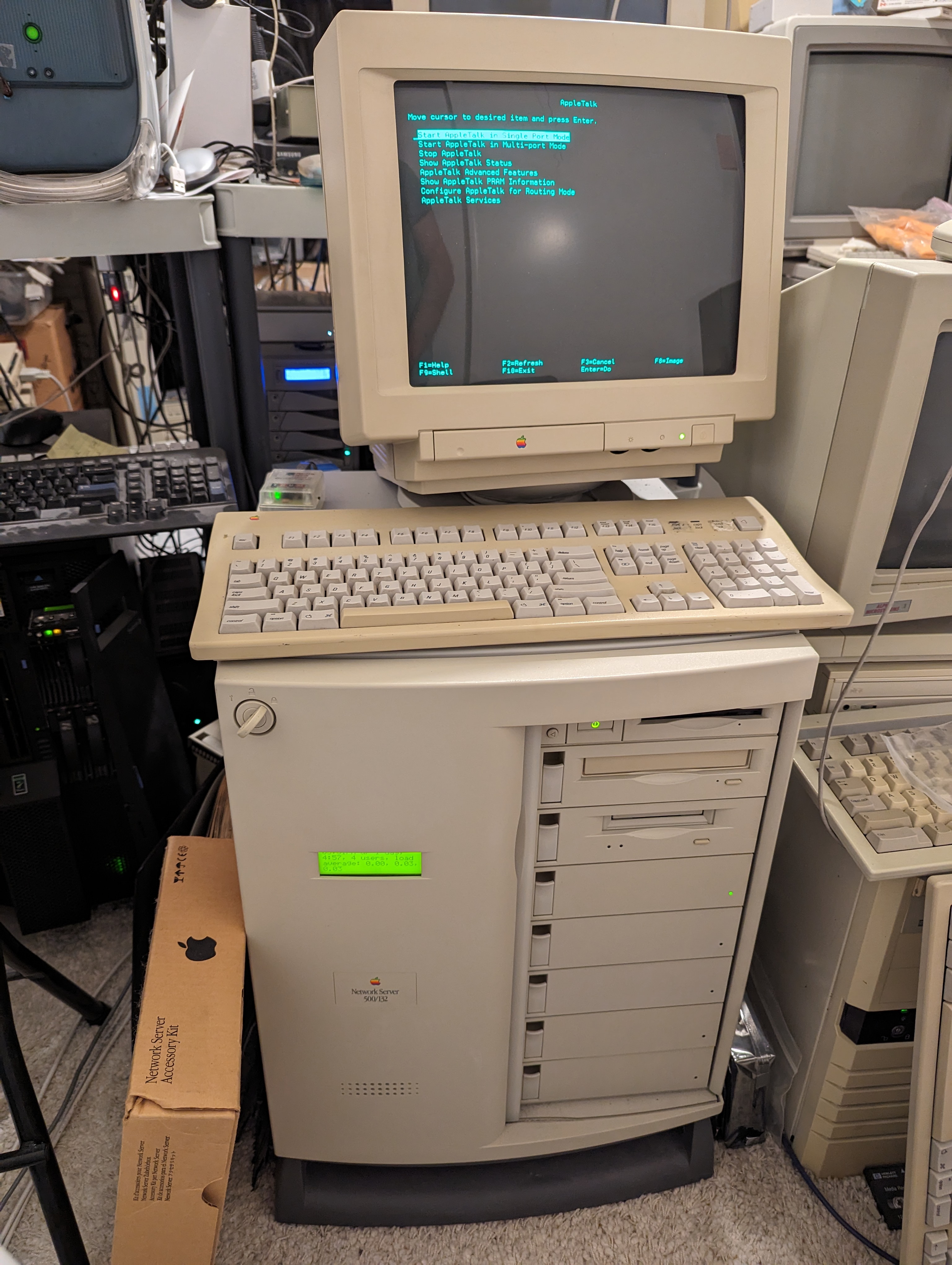
But they've started to surface, first with an ex-Apple employee who had both the preproduction ROM and the Mac OS ROM on a flash ROM SIMM, and later another employee turned up with the NT ROM, though sadly more is needed to make it actually run NT. It turned out that I also had the preproduction ROM in a box gathering dust, and a couple months ago we put both the preproduction ROMs and NT ROMs through their paces.
Well, thanks to Jeff Walther who generously built a few replica ROM DIMMs for me to test, we can now try the "2.0" MacOS ROMs on holmstock, our hard-working Apple Network Server 700 test rig (stockholm, my original ANS 500, is still officially a production unit). And there are some interesting things to report, especially when we pit the preproduction ROMs and this set head-to-head in MacBench, and even try booting Rhapsody on it.Saturday, May 2, 2026
Testing MacOS on the Apple Network Server 2.0 ROMs
Sunday, October 26, 2025
The Apple Network Server MacOS ROMs have resurfaced
Still, it was a relatively open secret that the ANS was heavily derived from existing Power Macintosh hardware, most closely the Power Macintosh 9500, and early "Shiner" prototype systems were even demonstrated with MacOS. This was apparently the underpinning of Apple's brief flirtation with NetWare as a server OS, variously codenamed Wormhole, Deep Space Nine and most famously Cyberpunk. Then-CEO Michael Spindler made public statements supporting NetWare on Apple hardware; Wormhole was reportedly demonstrated on an early prototype likely of the Workgroup Server 9150 and Cyberpunk was explicitly meant for Shiner. Cyberpunk will no longer run on an ANS with production ROMs, but reportedly did run on ANSes with pre-production ROMs that could still boot MacOS, and does run on early NuBus Power Macs like the Power Macintosh 6100, which is how we demonstrated it. However, potential customers strongly preferred a Unix option and Apple had an arrangement with IBM around AIX, and so as the last operating system still standing that's what the ANS ended up running. Production ANSes as sold with the standard Open Firmware 1.1.22 ROMs lock MacOS out entirely and you get a message like this:
Although an old nerds' tale circulated at the time saying you could pull 9500 ROMs, put in a video card and boot from an external hard disk (because the video chip and internal SCSI controller are unique to the ANS and weren't supported by the 9500 or MacOS), this couldn't possibly have worked because among other things the Bandits in the ANS are mapped differently. Lots of people, including yours truly, had certainly tried. Still, I was used to AIX as an AIX administrator since the 3.2.5 days on real RS/6000 hardware and the ANS ran it splendidly, so today mine still runs it (4.1.5 is the last AIX release supported). But to me the best thing about the ANS was that I got a big beefy RISC server for a summer's work, so I didn't have to plump down a credit card. For everyone else, the ANS was expensive (starting at $10,000+ in 1996, a cool $20 grand in 2025 dollars) and Apple wasn't moving many. CEO Gil Amelio had lured Ellen Hancock away from National Semiconductor as Apple's new CTO and tasked her with finding a new path for the MacOS, though in the meantime Apple had this big hulking midrange server that wasn't selling. So, as an attempt to juice sales, Hancock announced at Comdex 1996 that the ANS would be able to run other operating system choices, not just AIX. MacOS was an obvious one because it already had before, but Hancock also proposed Windows NT to the great surprise of attendees. While Windows NT was built to be system-agnostic and versions already ran on PowerPC hardware, and people have since hacked it to run on Power Macs, this would have been the first time it could officially ever run on an Apple machine.Hancock's assertion was a simple ROM change would do it, and as it happens the ROMs on the ANS are conveniently on a small daughtercard that can be replaced. However, it seems that the market was sceptical this could work — heck, I was sceptical while doing the story research, since I knew no such ROMs were ever publicly sold — and the recently-returned Steve Jobs talked Amelio into cancelling the ANS line and OpenDoc both on the same day in 1997. Nothing more ever turned up about either option.
Recently a former employee who was on the business development team for Apple's server products posted on the Tinker Different boards: not only did he have the mythical MacOS ROM, he had it installed in a Deep Dish booting the MacOS. Deep Dish was the code name for the planned but unreleased ANS 300, a small rackmountable version (as opposed to the rackmount plates Apple sold for the 500 and 700 which take up a whopping 19U), so here was a prototype machine running development ROMs booting an operating system it was never actually sold with. More to the point, he confirmed the Windows NT ROMs actually did exist and worked as well.Though he didn't have the NT ROMs, he did dump the two development ROMs he had (a third is in progress) which included the MacOS ROM — and now we have them for analysis. What's interesting is that both the explicit MacOS ROM and the Open Firmware 2.26b6 ROM he dumped seem capable of booting MacOS, though the 2.2 ROM has strings saying MacOS is unsupported, use at your own risk. and MacOS requires PCI video card and external SCSI boot disk. (which may lend credence to that old nerds' tale, assuming you had the right ROMs, not the 9500's). However, the full MacOS ROM reportedly "just works," all the way to Mac OS 9; one wonders if with XPostFacto you could drag it into OS X that way, giving it another Unix option besides AIX, Linux and NetBSD, the driver issue notwithstanding. Though the MacOS ROM does not use the ANS's front-mounted LCD, which is one of its best features, it wouldn't seem difficult to come up with an INIT extension for it. A particularly tantalizing thought is this might also get Cyberpunk running on a Shiner for the first time since 1996, the very machine it was intended for.
To make all that happen, of course, we next need to get the MacOS ROM on an actual ROM card. The ROMs this individual had were flashable and I need to do some looking at mine, and the connectors aren't common. Nevertheless, the first step is to actually have the ROM and now we do. I'm hopeful that this breakthrough might encourage further exploration of my favourite Apple server and that someone out there has the NT ROMs and steps forward. The Apple Network Server was always a cult favourite as one of Apple's more notorious white elephants and now almost 30 years after its introduction there may be even more fun things to do on it. If you know where to find them, post in the comments or drop me a line at ckaiser at floodgap dawt com (happy to keep you anonymous if you prefer which I have done for other former Apple engineers in the past).
Saturday, May 31, 2025
Harpoom: of course the Apple Network Server can be hacked into running Doom
Now, let's go ahead and get the grumbling out of the way. No, the ANS is not running Linux or NetBSD. No, this is not a backport of NCommander's AIX Doom, because that runs on AIX 4.3. The Apple Network Server could run no version of AIX later than 4.1.5 and there are substantial technical differences. (As it happens, the very fact it won't run on an ANS was what prompted me to embark on this port in the first place.) And no, this is not merely an exercise in flogging a geriatric compiler into building Doom Generic, though we'll necessarily do that as part of the conversion. There's no AIX sound driver for ANS audio, so this port is mute, but at the end we'll have a Doom executable that runs well on the ANS console under CDE and has no other system prerequisites. We'll even test it on one of IBM's PowerPC AIX laptops as well. Because we should.
Saturday, April 5, 2025
MacLynx beta 6: back to the Power Mac
Saturday, May 4, 2024
With PowerPC, Windows CE and the WiiN-PAD slate, everyone's a WiiN-er (except Data General)
And, well, no. I can't think of a single product from that particular salvo that actually survived, let alone thrived. But we've got one of them here — and, as you might expect, there's a few odd things about it. First off, it's a slate. (We call them tablets now, kids.)
Not a vanishingly rare form factor for a Windows CE device, though hardly the most common. It's also got a full-size dock, a camera and ... a Data General badge? The Nova-AViiON-CLARiiON-Data General/One Data General that put two I's into everything? Yup, it's really that Data General with that naming convention. In fact, as the history will show, the Data General WiiN-PAD is quite possibly the last computing device DG ever produced before EMC bought them out and shut (most of) them down in 1999. (No, near as I can determine, the name WiiN-PAD has nothing to do with the unreleased Microsoft WinPad.)But that's not the really wacky part. Check out the CPU it's running.
That's right: it's PowerPC, the most unloved of the architectures CE ever ran on — in fact, this is the first PowerPC Windows CE device I've ever found, and I'm the self-described biggest pro-PowerPC bigot in the world. Here's an unusual form factor Windows CE device, running on the operating system's least used CPU, from a storied computer company near the end of its run, intended for medical applications, produced in very small numbers and cancelled within months.What are we going to do with it? Well, what do you think we're gonna do with it? We're going to program it, so that we can finally have some software! And, of course, since this wacky thing was there at the bitter end, we'll talk more about the last days of Data General and what happened next.
Saturday, December 23, 2023
When the Power Macintosh ran NetWare (featuring Wormhole and Cyberpunk)
Why, the very mention of NetWare almost certainly caused those of you familiar with it to get an instant mental image of MONITOR.NLM, like this as shown in Bochs:
But Novell wanted NetWare servers to be more than just PCs (and the PC ecosystem to be more than just Microsoft), and in an attempt to gain footholds elsewhere the company accumulated some strange bedfellows. HP, Sun and Data General were on board, and IBM did so in grander form, but surely the most unexpected company Novell tried to court was ... Apple. Yes, that screenshot is a real Power Macintosh 6100 (actually a Performa 6116CD) in the Floodgap lab running exactly what you think it's running. As a matter of fact, that Apple logo superimposed on the '90s Novell "teeth" I led off with was a real resource image that came from it.No, I don't mean Macintoshes accessing NetWare servers as clients: we mean Macs as NetWare servers themselves. As proof, we'll take an entire tour of Power Macintosh NetWare on the 6116CD and try to boot it on the Apple Network Server, its actual intended target. NetWare on the Mac really existed as part of the same bizarro universe that ported the Macintosh Finder to Novell DR-DOS — meaning it's time for yet another weird Apple story during Apple's weirdest days.
Saturday, November 11, 2023
The Apple Network Server's all-too-secret weapon (featuring PPC Toolbox)
About a year later the University said they'd throw it in with my consultant compensation because they wanted to get rid of it anyway, so it became officially mine, and I was delighted to have it. That machine, later upgraded to 200MHz and 512MB of parity FPM RAM, variously powered my E-mail and the Floodgap gopher and webservers from 2000 to 2012, and still does backup duty when the POWER6 has to be down for repairs.
That's because the POWER6 runs everything the ANS did — because the ANS also runs AIX. The ANS 500 and 700 were not Apple's first Unix-specific servers (that would be the Apple Workgroup Server 95, a Quadra 950 using a special PDS card that only worked with A/UX, Apple's own Unix with a bolted-on Mac compatibility layer), but they were Apple's first Mac derivatives that could not boot classic Mac OS at all and natively ran a non-Apple operating system. Indeed, most people treated it as exactly that, a big Unix server from Apple, and at the time I did too.However, there was a secret weapon hidden in ANS AIX most of us at the time never knew about. Built-in to the operating system was a fully Unix-native AppleTalk stack and support for receiving and sending Apple Events, surfaced in the form of Apple's disk administration tools and AppleShare. But Apple had a much more expansive vision for this feature: full server-client "symbiotic" applications that could do their number-crunching on the ANS and present the results on a desktop Mac. Using the Program-to-Program Communication Toolbox ("PPCToolbox"), and because AIX's throughput far exceeded anything the classic Mac OS ever could ever handle, an ANS could augment a whole bunch of Macs at once that didn't have to stop to do the work themselves.
Well, today we're going to write one of those "symbiotic" applications doing something this little Mystic Color Classic could never efficiently do itself — accessing and processing a JSON API over TLS 1.3 — and demonstrate not only how such an client application looked on the Mac side, but also how the server component worked on the AIX side. If you're lucky enough to have an ANS running AIX too, you can even compile and run it yourself. But before we do that, it might be a little instructive to talk about how the Apple Network Server came to run AIX in the first place.
Saturday, October 14, 2023
Teaching Apple Cyberdog 1.0 new tricks (featuring OpenDoc)
Cyberdog's initial release belied some wild changes afoot, for in the world it inhabited, the document told the system what it needed to display, and the parts within the document displayed it. The document ruled all. The document was king.
And all of this came together in a special Cyberdog software development kit, complete with example code and the very first 1.0 release of the browser. Now that we have our PowerBook Duo 2300 rehabilitated, guess what we're gonna look at?
Saturday, September 2, 2023
Refurb weekend: PowerBook Duo 2300c
But being Apple's smallest laptop — even today the Duos are still the fourth smallest, width-height-wise — wasn't the (main) point of the Duos. Arguably, the main point was the Dock. Even Jerry Seinfeld had one.
With the Dock, your little, relatively underpowered laptop was hoovered up into a beige plastic maw to make it into an average-sized, somewhat less underpowered desktop. But you got slots and ports and the ability to use it like a desktop computer — two computers in one! — and that was crucial because without any Dock, even the smaller Mini and MicroDocks, you had hardly any ports at all (MacBook Air has entered the chat). Docking was so important that Apple even intentionally gimped the 2300 by keeping the 100MHz 603e on a 32-bit bus to maintain Dock compatibility. Yet because Duos were irrepressibly cute, they turned up in many other TV shows and even movies, most notoriously Hackers: (People hate on Kate Libby's offhand comment that it has the new "P6 chip" especially when the trackball gives it away as a 68K Duo, but allegedly the unit in the film had a 2300 logic board, Apple did call the 60x series "P6" in some marketing material, and the "28.8 bps" [sic] modem did at least exist as a prototype. The greater technical sin is Dade Murphy saying it has a PCI bus even though no Duo ever did; the first PowerBook to be PCI was the 3400.) Unfortunately, one of my two 2300c systems is showing evidence of the same problem that ruined the front of my favourite PowerBook 1400: the metal hinges are starting to tear out of their attachment points in the plastic back of the display, and naturally it's the one with all the upgrades in it. The most common symptom, besides bulging or split hinges when the display is closed at the point where the back and front come together, is the bottom front bezel cracking from the strain as you open it. If you learn one thing from this blog post, when opening pre-G3 PowerBooks, place your thumbs on each side of the bottom bezel of the display as you open them to support the hinge attachments. It's time for a Refurb Weekend.
Saturday, October 8, 2022
Going where BeOS NetPositive hasn't gone before: NetPositive+
(How do you pronounce BeOS?)
This is a real 133MHz BeBox running otherwise stock BeOS R5, surfing Hacker News and Lobste.rs using a modified, bug-fixed NetPositive wired to offload encryption to an onboard copy of Crypto Ancienne (see my notes on the BeOS port). NetPositive is the only known browser on the PowerPC ports of BeOS — it's probably possible to compile Lynx 2.8.x with BeOS CodeWarrior, but I've only seen it built for Intel, and Mozilla and Opera were definitely Intel/BONE-only. With hacks for self-hosted TLS bolted on, NetPositive's not fast but it works, and supports up to TLS 1.2 currently due to BeOS stack limitations.
Monday, May 30, 2022
So long, home T1 line; hello, hacking the T1 router
T1 lines have never been cheap, though back in the day they were prized because at 1.536 Mbit/s each way they were comparatively high capacity. At my first job out of college in 1997 the university had a T1 connected to an AdTran CSU/DSU, adding more T1 lines on and bonding them for additional bandwidth until they upgraded to optical fiber. A friend of mine in the very late 1990s had his own residential T1 (this was when consumer DSL was uncommon and 56K dialup was still frequent) that his employer paid the bill for, reportedly close to a cool grand a month in those days; he would never been able to afford it otherwise. On a cost basis alone (and certainly dollars per megabit) a T1 would have been far from my first choice, but I needed a reliable server-grade connection and I couldn't find any other alternatives at the time, so if I wanted to get my hardware back online from the house I was going to have to pay up and get one. Rather than use the actual telephone company I went with an overlay vendor and was quoted $295 a month on an annual contract for a 16-address netblock plus $199 installation. Now going into my fourth week of downtime, I signed immediately. They called the telco who came out the next week, installed the smartjack (we'll talk about what this is), took over both telephone wire pairs to the house and wired it into the pedestal — conveniently, the local telco pedestal is literally in my backyard. Good thing I'd already moved the house alarm modem to a wireless connection since I could no longer have a landline now. I then ran lines from the smartjack into the server room (thanks to the telephone guys I used to work next to when I was consulting I already had good experience with a punchdown tool), the vendor came out the week after that with the T1 router, and finally Floodgap was back up.
The original idea was to use the T1 until something less expensive came along, but the T1 just plain worked and was always highest priority on service calls, so inertia and inflation eventually turned the $295 a month into $399 and a 12-month contract into 48. Still, it was a tariffed line with a service-level agreement, I had plenty of addresses and my personal bandwidth requirements have always been modest — I don't cloud, I rarely stream and YouTube is worse than television — so I ended up just using the T1 as my personal ISP at the same time and avoiding a second bill. This worked out fine for awhile except, of course, for love. My wife needed her Netflix and her iCloud, and by then the previously intransigent cable provider had been bought by someone else (fiber? hahahaha) who didn't know any of the previous history; they came out and finally pulled an RG-6 cable run five years after the fact, and switched us on. I moved the Wi-Fi to the new cable net and her bandwidth needs were thus met in the manner to which she was accustomed. We joke about the his'n'hers networks: I still had my lab and servers on the T1, and everything else including her devices was on the cable.
Well, it was good we did that because I mentioned in January this year that the vendor (which had changed owners twice over the years) was abruptly getting out of the residential T1 business and I had a month before it was switched off. I may well have been their last customer in the region. So I'd like to publicly thank John who reached out and offered a no-strings VPN arrangement — which I'm routing over the cable — to keep Floodgap online while we consider our housing options in a market as bad as it was good when I first bought the place. We turned the VPN on and the vendor turned the T1 off. They never asked for the router back and the smartjack still sits in the back of the house.
Now it's Memorial Day in the United States and I suppose I'll have to do something about that now superfluous wiring run sometime soon. Before I do, though, let's document the T1 for a generation who may have never seen one ... and figure out something fun to do with the router they left behind other than, you know, routing stuff.
Like every computing story, this one begins with a box.
Sunday, October 3, 2021
Shiner ESB, an Apple Network Server prototype, and what it did at Netscape/MCom
The ANS, however, was a real honest to goodness server with hotswappable drive bays and fans, and (its most notable feature) an award-winning lockable translucent door so you could keep the unwashed masses out of your drives but still watch the blinkenlights. If you bought the bigger model, you even got dual power supplies and additional rear bays.
Also notable about the ANS was that they weren't supposed to run Mac OS, and were never sold with it, not least of which because the classic Mac OS wasn't really up to the task of being a server. Unfortunately, while A/UX supported larger needs on the 68K-based Workgroup Servers that could run it, A/UX 3 couldn't run on Power Macs even under emulation. The plan with A/UX 4 was to use a new PowerPC-native OSF/1-based kernel and possibly to also integrate portions of IBM's AIX operating system, but this plan (along with Taligent and other doomed projects) stalled out with everything else in Apple around that period. For a time Apple even considered using Novell NetWare on PowerPC; the port actually existed, codenamed Wormhole, but its tepid reception eventually led to the release of the weird Workgroup Server 9150 which just ran Mac OS. Eventually, to get to market Apple reached for what was then the only professional-level Un*x running on the new PowerPC architecture, which was AIX itself. Three Apple Network Server models were developed but only two (the "Low End" 500 and "High End" 700) were released; the 3U rack 300 "Deep Dish" remained solely a prototype, which I'd still love to acquire if its current owner ever gets tired of it. Oddly, even though they were only ever sold as AIX machines, they were initially demonstrated running Mac OS (possibly a custom version), further confusing potential customers who already didn't want to buy Workgroup Servers. Introduced in 1996 at a retail cost starting north of US$10,000, which didn't even include the AIX license, they were very poor sellers and the line was canned by Gil Amelio around a year later.
I got my ANS 500 barely used for the cost of some consulting work after Apple stopped supporting it; you can see some scanned Polaroids of when it was in production way back in 1998. Later, I acquired an ANS 700 which I use as a spare and was briefly in service while I diagnosed a hardware issue with the 500. More recently, however, I managed to land a Shiner HE prototype dated 1995 from a scrapper in San Rafael, California. That is the unit depicted in these pictures.
Sunday, March 7, 2021
Over the weekend: Commodore 128DCR keyboard extension, updates to Be-Power
Also, I was pointed to some additional BeOS PowerPC files, so I deduped and sorted them, and they are on Be-Power. Among other things there are now many more apps and also some of the OS updates. I also heard from someone who claims to have the old ftp.be.com archive completely mirrored, though for obvious reasons I'm mostly just interested in the PowerPC stuff. Haven't heard back from him yet when I asked for more details, but that's very encouraging for having a nearly complete mirror.