But they've started to surface, first with an ex-Apple employee who had both the preproduction ROM and the Mac OS ROM on a flash ROM SIMM, and later another employee turned up with the NT ROM, though sadly more is needed to make it actually run NT. It turned out that I also had the preproduction ROM in a box gathering dust, and a couple months ago we put both the preproduction ROMs and NT ROMs through their paces.
Well, thanks to Jeff Walther who generously built a few replica ROM DIMMs for me to test, we can now try the "2.0" MacOS ROMs on holmstock, our hard-working Apple Network Server 700 test rig (stockholm, my original ANS 500, is still officially a production unit). And there are some interesting things to report, especially when we pit the preproduction ROMs and this set head-to-head in MacBench, and even try booting Rhapsody on it.Saturday, May 2, 2026
Testing MacOS on the Apple Network Server 2.0 ROMs
Sunday, January 25, 2026
Hands-on with two Apple Network Server prototype ROMs
Here's why I need to do inventory more often.
This is an Apple prototype ROM I am ashamed to admit I found in my own box of junk from various Apple Network Server parts someone at Apple Austin sent me in 2003. The 1996 Apple Network Server is one of Apple's more noteworthy white elephants and, to date, the last non-Macintosh computer (iOS devices notwithstanding) to come from Cupertino. Best known for being about the size of a generous dorm fridge and officially only running AIX 4.1, IBM's proprietary Unix for Power ISA, its complicated history is a microcosm of some of Apple's strangest days during the mid-1990s. At $10,000+ a pop (in 2026 dollars over $20,700), not counting the AIX license, they sold poorly and were among the first products on the chopping block when Steve Jobs returned in 1997.stockholm, my own Apple Network Server 500, was a castoff I got in 1998 — practically new — when the University bookstore's vendor wouldn't support the hardware and it got surplused. It was the first Unix server I ever owned personally, over the years I ended up installing nearly every available upgrade, and it ran Floodgap.com just about nonstop until I replaced it with a POWER6 in 2012 (for which it still functions as an emergency reserve). Plus, as the University was still running RS/6000 systems back then, I had ready access to tons of AIX software which the ANS ran flawlessly. It remains one of the jewels of my collection.
So when the mythical ANS MacOS ROM finally surfaced, I was very interested. There had always been interest in getting the ANS to run MacOS back in the day (I remember wasting an afternoon trying with a Mac OS 8 CD) and it was a poorly-kept secret that at various points in its development it could, given its hardware basis as a heavily modified Power Macintosh 9500. Apple itself perceived this interest, even demonstrating it with Mac OS prior to its release, and leading then-CTO Ellen Hancock to later announce that the ANS would get ROM upgrades to allow it to run both regular Mac OS and, in a shock to the industry, Windows NT. This would have made the ANS the first and only Apple machine ever sold to support it.
Well, guess what. This is that pre-production ROM Apple originally used to demonstrate Mac OS, and another individual has stepped up with the NT ROMs which are also now in my possession. However, at that time it wasn't clear what the prototype ROM stick was — just a whole bunch of flash chips on a Power Mac ROM DIMM which my Apple contacts tell me was used to develop many other machines at the time — and there was no way I was sticking it into my beloved production 500. But we have a solution for that. Network Servers came in three sizes: the rackmount ANS 300 ("Deep Dish") which was never released except for a small number of prototypes, the baseline ANS 500 ("Shiner LE"), and the highest tier ANS 700 ("Shiner HE") which added more drive bays and redundant, hot-swappable power supplies.
Which brings us to this machine.
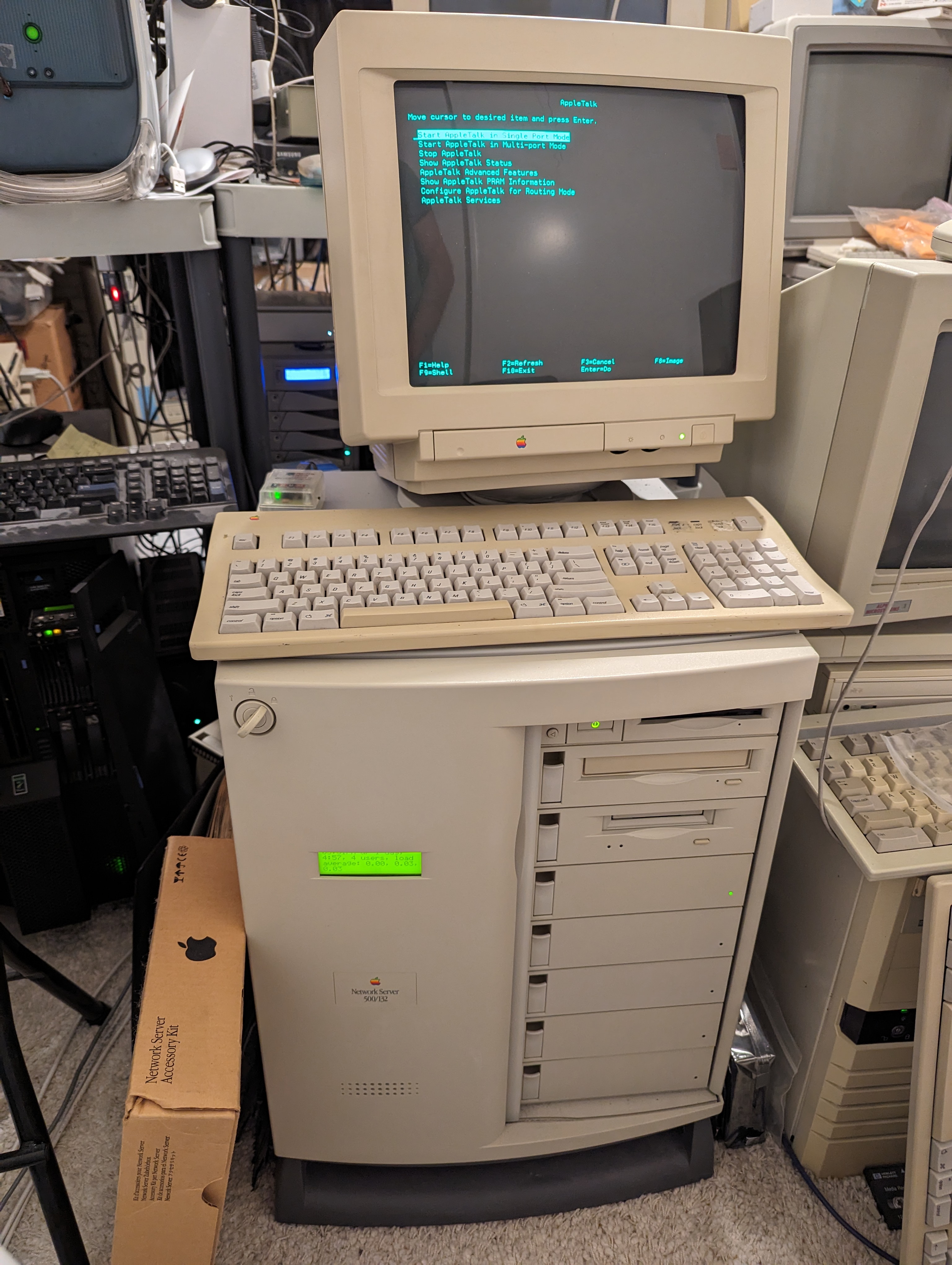
Meet holmstock, my Network Server 700, and the second ANS in my collection (the third is my non-functional Shiner ESB prototype). This was a ship of Theseus that my friend CB and I assembled out of two partially working but rather thrashed 700s we got for "come and get them" in August 2003. It served as stockholm's body double for a number of years until stockholm was retired and holmstock went into cold storage as a holding bay for spare parts. This makes it the perfect system to try a dodgy ROM in.I'll give you a spoiler now: it turns out the NT ROM isn't enough to install Windows NT by itself, even though it has some interesting attributes. Sadly this was not unexpected. But the pre-production ROM does work to boot Mac OS, albeit with apparent bugs and an injection of extra hardware. Let's get the 700 running again (call it a Refurb Weekend) and show the process.
Sunday, October 26, 2025
The Apple Network Server MacOS ROMs have resurfaced
Still, it was a relatively open secret that the ANS was heavily derived from existing Power Macintosh hardware, most closely the Power Macintosh 9500, and early "Shiner" prototype systems were even demonstrated with MacOS. This was apparently the underpinning of Apple's brief flirtation with NetWare as a server OS, variously codenamed Wormhole, Deep Space Nine and most famously Cyberpunk. Then-CEO Michael Spindler made public statements supporting NetWare on Apple hardware; Wormhole was reportedly demonstrated on an early prototype likely of the Workgroup Server 9150 and Cyberpunk was explicitly meant for Shiner. Cyberpunk will no longer run on an ANS with production ROMs, but reportedly did run on ANSes with pre-production ROMs that could still boot MacOS, and does run on early NuBus Power Macs like the Power Macintosh 6100, which is how we demonstrated it. However, potential customers strongly preferred a Unix option and Apple had an arrangement with IBM around AIX, and so as the last operating system still standing that's what the ANS ended up running. Production ANSes as sold with the standard Open Firmware 1.1.22 ROMs lock MacOS out entirely and you get a message like this:
Although an old nerds' tale circulated at the time saying you could pull 9500 ROMs, put in a video card and boot from an external hard disk (because the video chip and internal SCSI controller are unique to the ANS and weren't supported by the 9500 or MacOS), this couldn't possibly have worked because among other things the Bandits in the ANS are mapped differently. Lots of people, including yours truly, had certainly tried. Still, I was used to AIX as an AIX administrator since the 3.2.5 days on real RS/6000 hardware and the ANS ran it splendidly, so today mine still runs it (4.1.5 is the last AIX release supported). But to me the best thing about the ANS was that I got a big beefy RISC server for a summer's work, so I didn't have to plump down a credit card. For everyone else, the ANS was expensive (starting at $10,000+ in 1996, a cool $20 grand in 2025 dollars) and Apple wasn't moving many. CEO Gil Amelio had lured Ellen Hancock away from National Semiconductor as Apple's new CTO and tasked her with finding a new path for the MacOS, though in the meantime Apple had this big hulking midrange server that wasn't selling. So, as an attempt to juice sales, Hancock announced at Comdex 1996 that the ANS would be able to run other operating system choices, not just AIX. MacOS was an obvious one because it already had before, but Hancock also proposed Windows NT to the great surprise of attendees. While Windows NT was built to be system-agnostic and versions already ran on PowerPC hardware, and people have since hacked it to run on Power Macs, this would have been the first time it could officially ever run on an Apple machine.Hancock's assertion was a simple ROM change would do it, and as it happens the ROMs on the ANS are conveniently on a small daughtercard that can be replaced. However, it seems that the market was sceptical this could work — heck, I was sceptical while doing the story research, since I knew no such ROMs were ever publicly sold — and the recently-returned Steve Jobs talked Amelio into cancelling the ANS line and OpenDoc both on the same day in 1997. Nothing more ever turned up about either option.
Recently a former employee who was on the business development team for Apple's server products posted on the Tinker Different boards: not only did he have the mythical MacOS ROM, he had it installed in a Deep Dish booting the MacOS. Deep Dish was the code name for the planned but unreleased ANS 300, a small rackmountable version (as opposed to the rackmount plates Apple sold for the 500 and 700 which take up a whopping 19U), so here was a prototype machine running development ROMs booting an operating system it was never actually sold with. More to the point, he confirmed the Windows NT ROMs actually did exist and worked as well.Though he didn't have the NT ROMs, he did dump the two development ROMs he had (a third is in progress) which included the MacOS ROM — and now we have them for analysis. What's interesting is that both the explicit MacOS ROM and the Open Firmware 2.26b6 ROM he dumped seem capable of booting MacOS, though the 2.2 ROM has strings saying MacOS is unsupported, use at your own risk. and MacOS requires PCI video card and external SCSI boot disk. (which may lend credence to that old nerds' tale, assuming you had the right ROMs, not the 9500's). However, the full MacOS ROM reportedly "just works," all the way to Mac OS 9; one wonders if with XPostFacto you could drag it into OS X that way, giving it another Unix option besides AIX, Linux and NetBSD, the driver issue notwithstanding. Though the MacOS ROM does not use the ANS's front-mounted LCD, which is one of its best features, it wouldn't seem difficult to come up with an INIT extension for it. A particularly tantalizing thought is this might also get Cyberpunk running on a Shiner for the first time since 1996, the very machine it was intended for.
To make all that happen, of course, we next need to get the MacOS ROM on an actual ROM card. The ROMs this individual had were flashable and I need to do some looking at mine, and the connectors aren't common. Nevertheless, the first step is to actually have the ROM and now we do. I'm hopeful that this breakthrough might encourage further exploration of my favourite Apple server and that someone out there has the NT ROMs and steps forward. The Apple Network Server was always a cult favourite as one of Apple's more notorious white elephants and now almost 30 years after its introduction there may be even more fun things to do on it. If you know where to find them, post in the comments or drop me a line at ckaiser at floodgap dawt com (happy to keep you anonymous if you prefer which I have done for other former Apple engineers in the past).
Saturday, May 31, 2025
Harpoom: of course the Apple Network Server can be hacked into running Doom
Now, let's go ahead and get the grumbling out of the way. No, the ANS is not running Linux or NetBSD. No, this is not a backport of NCommander's AIX Doom, because that runs on AIX 4.3. The Apple Network Server could run no version of AIX later than 4.1.5 and there are substantial technical differences. (As it happens, the very fact it won't run on an ANS was what prompted me to embark on this port in the first place.) And no, this is not merely an exercise in flogging a geriatric compiler into building Doom Generic, though we'll necessarily do that as part of the conversion. There's no AIX sound driver for ANS audio, so this port is mute, but at the end we'll have a Doom executable that runs well on the ANS console under CDE and has no other system prerequisites. We'll even test it on one of IBM's PowerPC AIX laptops as well. Because we should.
Saturday, December 23, 2023
When the Power Macintosh ran NetWare (featuring Wormhole and Cyberpunk)
Why, the very mention of NetWare almost certainly caused those of you familiar with it to get an instant mental image of MONITOR.NLM, like this as shown in Bochs:
But Novell wanted NetWare servers to be more than just PCs (and the PC ecosystem to be more than just Microsoft), and in an attempt to gain footholds elsewhere the company accumulated some strange bedfellows. HP, Sun and Data General were on board, and IBM did so in grander form, but surely the most unexpected company Novell tried to court was ... Apple. Yes, that screenshot is a real Power Macintosh 6100 (actually a Performa 6116CD) in the Floodgap lab running exactly what you think it's running. As a matter of fact, that Apple logo superimposed on the '90s Novell "teeth" I led off with was a real resource image that came from it.No, I don't mean Macintoshes accessing NetWare servers as clients: we mean Macs as NetWare servers themselves. As proof, we'll take an entire tour of Power Macintosh NetWare on the 6116CD and try to boot it on the Apple Network Server, its actual intended target. NetWare on the Mac really existed as part of the same bizarro universe that ported the Macintosh Finder to Novell DR-DOS — meaning it's time for yet another weird Apple story during Apple's weirdest days.
Saturday, November 11, 2023
The Apple Network Server's all-too-secret weapon (featuring PPC Toolbox)
About a year later the University said they'd throw it in with my consultant compensation because they wanted to get rid of it anyway, so it became officially mine, and I was delighted to have it. That machine, later upgraded to 200MHz and 512MB of parity FPM RAM, variously powered my E-mail and the Floodgap gopher and webservers from 2000 to 2012, and still does backup duty when the POWER6 has to be down for repairs.
That's because the POWER6 runs everything the ANS did — because the ANS also runs AIX. The ANS 500 and 700 were not Apple's first Unix-specific servers (that would be the Apple Workgroup Server 95, a Quadra 950 using a special PDS card that only worked with A/UX, Apple's own Unix with a bolted-on Mac compatibility layer), but they were Apple's first Mac derivatives that could not boot classic Mac OS at all and natively ran a non-Apple operating system. Indeed, most people treated it as exactly that, a big Unix server from Apple, and at the time I did too.However, there was a secret weapon hidden in ANS AIX most of us at the time never knew about. Built-in to the operating system was a fully Unix-native AppleTalk stack and support for receiving and sending Apple Events, surfaced in the form of Apple's disk administration tools and AppleShare. But Apple had a much more expansive vision for this feature: full server-client "symbiotic" applications that could do their number-crunching on the ANS and present the results on a desktop Mac. Using the Program-to-Program Communication Toolbox ("PPCToolbox"), and because AIX's throughput far exceeded anything the classic Mac OS ever could ever handle, an ANS could augment a whole bunch of Macs at once that didn't have to stop to do the work themselves.
Well, today we're going to write one of those "symbiotic" applications doing something this little Mystic Color Classic could never efficiently do itself — accessing and processing a JSON API over TLS 1.3 — and demonstrate not only how such an client application looked on the Mac side, but also how the server component worked on the AIX side. If you're lucky enough to have an ANS running AIX too, you can even compile and run it yourself. But before we do that, it might be a little instructive to talk about how the Apple Network Server came to run AIX in the first place.
Sunday, October 3, 2021
Shiner ESB, an Apple Network Server prototype, and what it did at Netscape/MCom
The ANS, however, was a real honest to goodness server with hotswappable drive bays and fans, and (its most notable feature) an award-winning lockable translucent door so you could keep the unwashed masses out of your drives but still watch the blinkenlights. If you bought the bigger model, you even got dual power supplies and additional rear bays.
Also notable about the ANS was that they weren't supposed to run Mac OS, and were never sold with it, not least of which because the classic Mac OS wasn't really up to the task of being a server. Unfortunately, while A/UX supported larger needs on the 68K-based Workgroup Servers that could run it, A/UX 3 couldn't run on Power Macs even under emulation. The plan with A/UX 4 was to use a new PowerPC-native OSF/1-based kernel and possibly to also integrate portions of IBM's AIX operating system, but this plan (along with Taligent and other doomed projects) stalled out with everything else in Apple around that period. For a time Apple even considered using Novell NetWare on PowerPC; the port actually existed, codenamed Wormhole, but its tepid reception eventually led to the release of the weird Workgroup Server 9150 which just ran Mac OS. Eventually, to get to market Apple reached for what was then the only professional-level Un*x running on the new PowerPC architecture, which was AIX itself. Three Apple Network Server models were developed but only two (the "Low End" 500 and "High End" 700) were released; the 3U rack 300 "Deep Dish" remained solely a prototype, which I'd still love to acquire if its current owner ever gets tired of it. Oddly, even though they were only ever sold as AIX machines, they were initially demonstrated running Mac OS (possibly a custom version), further confusing potential customers who already didn't want to buy Workgroup Servers. Introduced in 1996 at a retail cost starting north of US$10,000, which didn't even include the AIX license, they were very poor sellers and the line was canned by Gil Amelio around a year later.
I got my ANS 500 barely used for the cost of some consulting work after Apple stopped supporting it; you can see some scanned Polaroids of when it was in production way back in 1998. Later, I acquired an ANS 700 which I use as a spare and was briefly in service while I diagnosed a hardware issue with the 500. More recently, however, I managed to land a Shiner HE prototype dated 1995 from a scrapper in San Rafael, California. That is the unit depicted in these pictures.