Wednesday, May 4, 2022

Gopher on the Palm Pilot and the pitfalls of PalmOS connectivity

To start, an apology for 18 years of tardiness.

In 2004 I was working on a gopher client for my Palm m505, written in Lua using the new hotness of Plua 1.x, which supported UI, graphics and networking built-in. I christened an early implementation as "Port-A-Goph" and it even got a mention in Wired. Due to socket bugs in that version that never got fixed, I deferred the release until I could rewrite Port-A-Goph for Plua 2. Over the next few years I worked on it intermittently but got distracted by other projects, and eventually after moved to iOS and then Android I stopped carrying a Palm around with me entirely. Since I have my own Gopher client on Android, the PalmOS version sat in suspended animation.

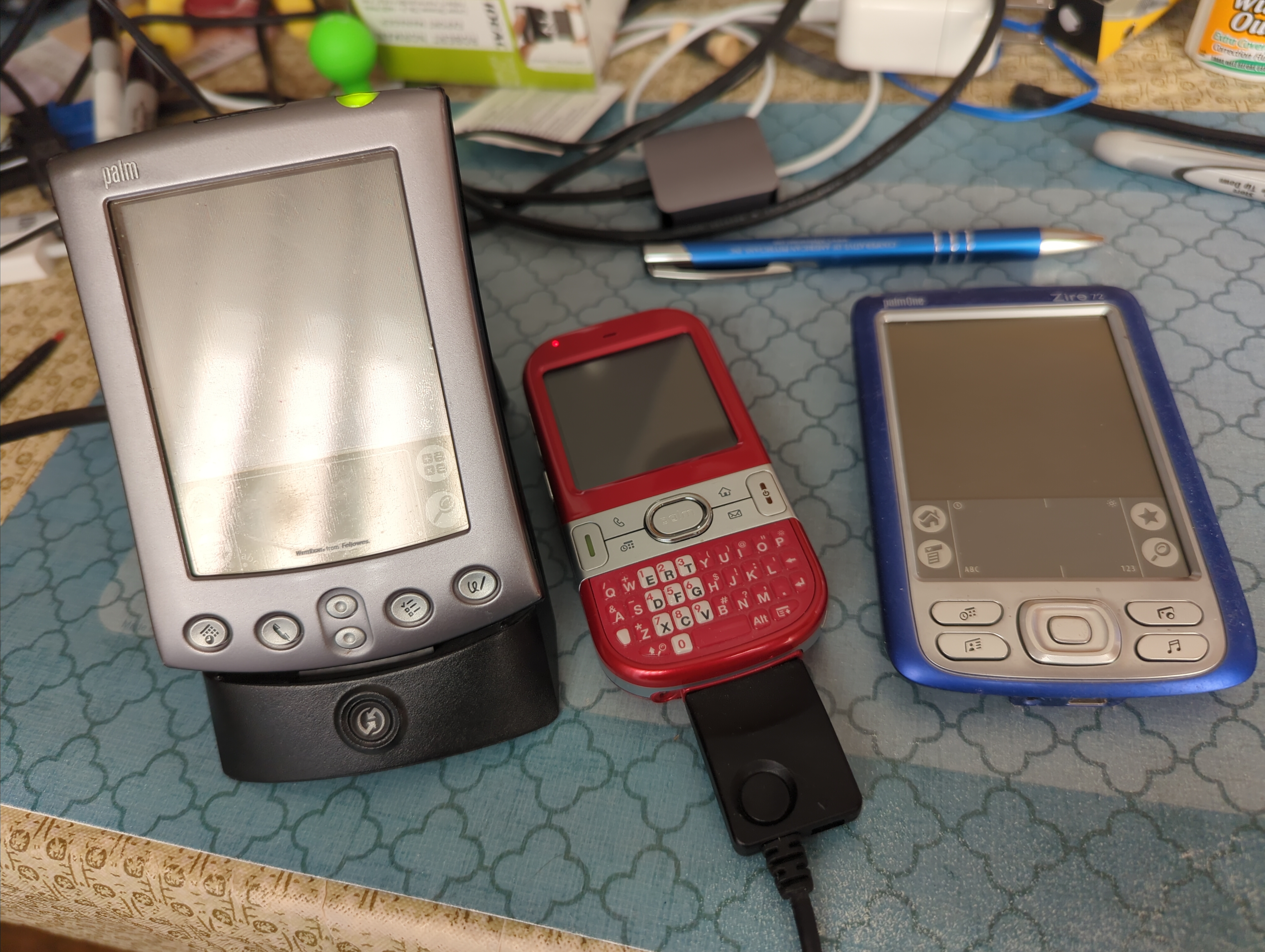
Well, it's time to dust off the resurrected Port-A-Goph, newly christened into the Overbite client family as Overbite Palm. Along the way we'll make sure it works on a selection of real hardware:

Sunday, April 10, 2022

Tonight we're gonna log on like it's 1979 (Telenet, Dialcom and The Source)

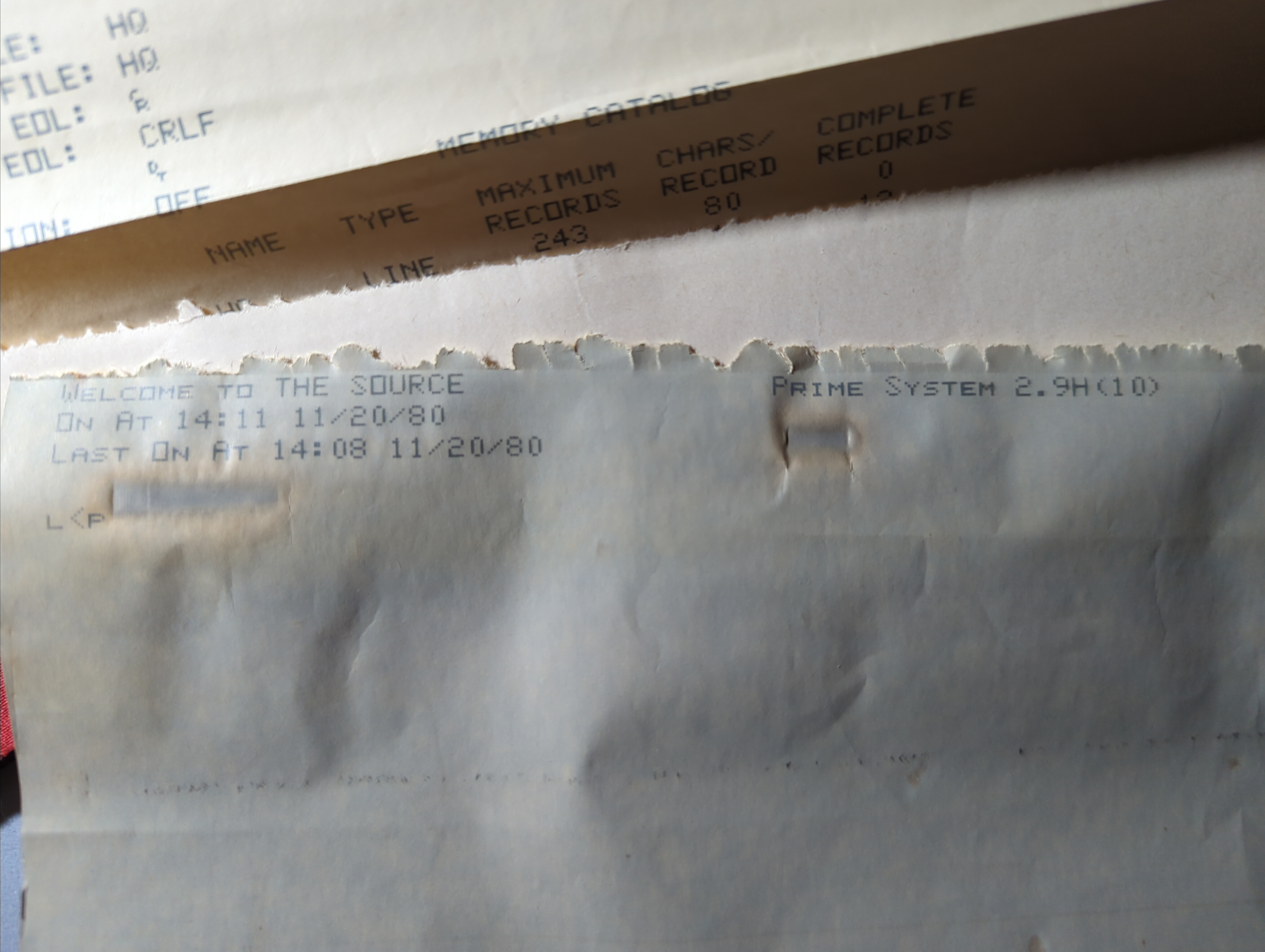
Teletypes may have killed a lot of forests by emitting every line to hard copy instead of a screen, but there's something to be said for the permanence of paper, especially when people hang onto it for some reason. While getting duff units to build a functional Silent 700 Model 765 ASR teletype, which will of course be a future article, one of them was more interesting for what else it came with: a set of teletype transcripts of several users logging onto The Source, one of the earliest online services, and a complete photocopy of the service's user manual. So get out your copy of Pink Floyd's The Wall, start blasting "In The Flesh," and let's head back to 1979 and 1980 when these transcripts were printed. We'll talk a little bit about the service generally and then log on exactly as these people did — because the Silent 700 transcripts indeed show exactly what transpired and how they used them.

Monday, March 28, 2022

prior-art-dept.: 5 letter words (Jim Butterfield's Jotto)

I mentioned the Wordle craze, including the extant ports to the Commodore 64, in our KIMdle sorta-Wordle for the KIM-1. But the Commodore 64, and I suspect this was actually a PET game originally, had a five-letter word game before that. Jim Butterfield's port of the 1955 Jotto board game isn't Wordle — it tells you merely how many letters matched — but it's undeniably an ancestor concept. Jotto appears in the Commodore 64 user's guide on page 145 and is believed to be public domain. It is reproduced in its entirety in this scanned image.

Friday, March 25, 2022

xa 2.3.13 and dxa 0.1.5

I've updated xa, André Fachat's venerable 6502 cross-assembler, to version 2.3.13, but also dxa, its companion disassembler based on Marko Mäkelä's d65, to version 0.1.5. I keep promising version 2.4, but somehow for years we never noticed that // and /* */ in quoted strings get improperly treated as comments instead of part of the string, and that seemed a pretty important bug to fix. A test case is now part of xa's fairly extensive regression analysis suite. 2.3.13 also includes patches for segfaults with parameter handling (but never run xa as root, kids, it kills kittens) and a miscellaneous correctness fix with null file handling. Although its development home platform remains AIX (with gcc) because I'm one of those people, and portability mumble mumble weird operating systems mumble endian, it is also tested and validated on Linux/ppc64le (gcc and clang), NetBSD/macppc and NetBSD/mac68k (gcc), and Mac OS X macOS (gcc on PowerPC, and clang on x86_64 and Apple silicon). Seriously, this is the last 2.3 release, dammit. No fooling. I mean it.

dxa's development was a little more colourful. This started with a file that didn't disassemble correctly (Paradoxon BASIC from 64'er, as it happens) because apparently d65 was never able to handle files that stretched riiiiiiiiiiiight up to the very last addressible byte ($ffff), let alone files that overflowed the addressing space or were bigger than 64K. However, even with that problem fixed, this particular test file also caused dxa to emit completely nonsense branches with unpossible displacements and even jumps to non-existent labels. This violates its core guarantee that you should be able to take dxa's output, feed it back into xa and get the binary you started with. It turns out that this is due to some weird C casts used for interpreting relative branches, so I made them more explicit, plus changes in the C preprocessor that caused the macro to check if a label exists to evaluate to true in one place and false in another. I think this file made a great test vector, so now dxa has a test suite too (make test; xa is naturally required) using it and a DOS wedge routine, and I'll probably throw in more exemplar code in the future. This new test suite is already earning its keep: it found a new bug when dxa is compiled with clang, which required even more reworking of the same section and some nearby code. Interestingly, even though now the test suite passes on all the same platforms as xa, dxa-built-with-clang generates subtly different output than dxa-built-with-gcc despite the fact the assembly files they both generate will yield bitwise identical binaries. Most of this seems to circulate around detecting vectors; clang flavour finds this in some places that gcc doesn't and vice versa. It's deterministic and predictable, but I'm not sure which one of them is "doing it right," so for now it'll be a curiosity until I can dig more into the differences.

Both xa and dxa are available under the GNU Public License v2.
Wednesday, February 23, 2022

KIMdle: Sorta-Wordle for the KIM-1

UPDATE: I'm trying to solve a debouncing bug for someone who reported it, though I can't reproduce it. If you have a similar issue on real hardware, please try the version up now.

Wordle mania (trademark, probably, of the New York Times) continues. My wife and I, who bonded over word games and later got married because that's how you pick a good life partner, play daily on a private instance, except that she's 19 hours ahead so she has to be careful not to give out spoilers. Retro has gotten into the action. There are Wordle ports for Windows 3.1, Palm Pilots, Game Boys and at least three versions for the Commodore 64, such as this, this and this poop themed one called Turdle, ha ha ha.

Still, however, while these ports ditch dependence on JavaScript and HTML, they still rely on other modern conveniences such as, you know, a screen, a keyboard, and multiple kilobytes of RAM.

You see where I'm going with this.

Thursday, February 17, 2022

Refurb weekend: Texas Instruments Silent 700 Model 745 teletype

The first terminal I ever used was a teletype. Somehow my buddy when we were in high school got a hold of this weird "printer typewriter" which was none other than one of the famous Texas Instruments Silent 700 series.

Friday, February 4, 2022

Overbite Android 0.2.6

UPDATE: I've received a couple reports the .apk doesn't install. The actual reason is that the keys, and thus the author signature, have changed and Android doesn't let you replace an app with another app signed by "someone else." Delete the old version and install this one fresh rather than installing it over the old one. Sorry about the inconvenience.

Overbite Android 0.2.6 is available, the (persistently alpha-quality) native Gopher client for Android. This is merely a maintenance update for version 0.2.5 to fix visual issues with dark mode and Android 12, and a couple edge crashes. The screenshot is from my Pixel 6 Pro (the camera still crashes on it, Google, damn your eyes) running Android 12 but this release will still work with and is tested all the way back to 4.0.3 (Ice Cream Sandwich). After all, this is a retrocomputing blog! Source code for Android Studio (built with Bumblebee) is available under the BSD license.

Unfortunately, it is likely that 0.2.x will be the last release of Overbite Android to support OS versions prior to 9.0 (Pie). This is because right now I'm running Android Studio on an M1 Mac (hoping to get it working properly on my Talos II, but not there yet) and it is apparently not possible to run API 27 or earlier under the emulator. (I tried myself and it just dies immediately. There should be a way to make it run within a full system emulator, but it doesn't.) For testing purposes I dug out an Intel MacBook Air with a previous version of Android Studio, booted up a emulated Galaxy Nexus with 4.0.3 and checked the APK installs and runs, but this is rather inconvenient to test with for obvious reasons, and Google doesn't make it easy for you to keep working with old Android versions if you're trying to also support new ones. For the time being, though, I still think supporting a 10+ year old release of a mobile operating system is pretty darn good, and if I do any other 0.2.x bugfixes I will at least test them to the extent I can on Android 4 before release.

Yes, I know Overbite Android still doesn't do downloads yet. This is largely laziness on my part, since I'm only scratching the itches I personally have, and I haven't needed to download files via Gopher to any of my Android devices so far. But that's probably the major feature I plan to introduce in 0.3 when I get some time to sit down and actually write the support.

Old releases compatible back to Android 1.5 (Cupcake) are still available, including source code.