Sunday, June 26, 2022
Overbite Palm 0.2
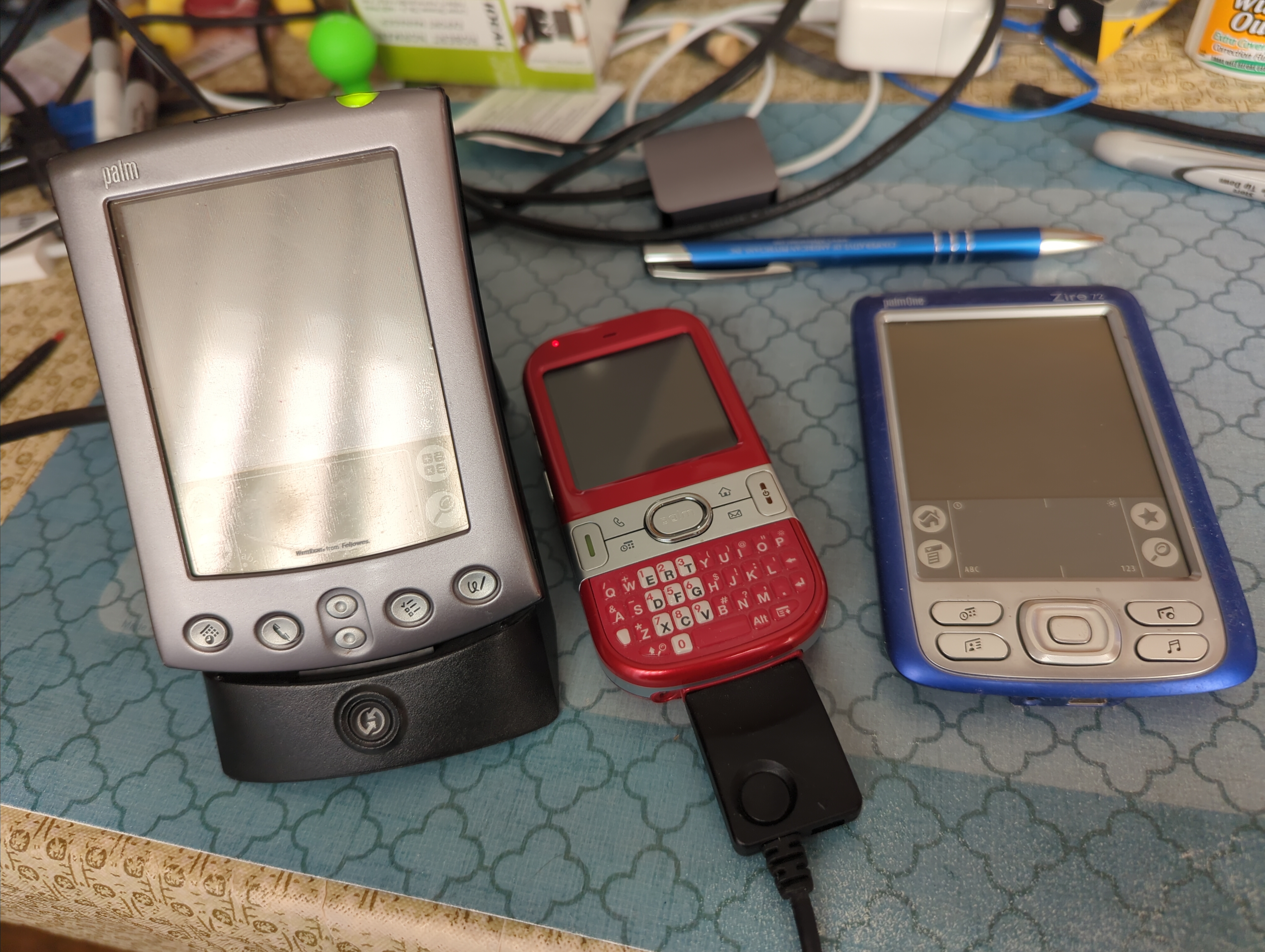
Overbite Palm 0.2, the Gopher client for classic Palm devices, is now available (see it running on real hardware). This update includes Shawn Mulligan's Sony Clié key patch (thanks!) plus more aggressive memory management and menu compression, which should not only increase the number and length of documents that 68K Palms with their pathetic dynamic heaps can view but also cut down on the fatal Plua-generated "out of memory" errors that our memory heuristics failed to anticipate. Additionally, all transfers are hard-capped to 32K raw data since this appears to be the empiric limit for the native scrolling text gadget. It was tested on my Palm Centro and AlphaSmart dana, as well as my emulated m515. You can get it from Github (plus Plua source, natch) and I will be making a place for it on the Floodgap gopher server as soon as I get a round tuit.
Saturday, June 11, 2022
prior-art-dept.: ProleText, encoding HTML before Markdown (and a modern reimplementation)
Steven P. Spackman allegedly once observed that "flat text is just never what you want." Which, I guess, is true: half the historical advances in computing have come from figuring out ways to tart up plain text, whether embedding control codes or out-of-band styling or in-band markup. However, with the exception of out-of-band styling (I always liked the Macintosh text file formats that kept the text in the data fork and the styling in a resource), you still needed to parse the file or at best you'd get blocks of text separated by gobbledygook. Enhanced text formats like Markdown were thus designed to make cognitive sense to human eyes without further parsing — but also encoding sufficient metadata to facilitate improved ways of rendering the document.
Markdown circa 2004 has displaced most of the others today, but it explicitly never claimed to be the first such human-readable format; indeed, AsciiDoc predates it by about two years, reStructuredText a year before that and MakeDoc about a year before that. For that matter, some of the concepts popularized in Markdown might not have existed at all were it not for earlier ancestors like 2002's Textile.
But a forgotten rich text language predates most of these, with the interesting property in that much of the markup is encoded using trailing whitespace, almost a fusion of in-band and out-of-band styling systems. If the whitespace is munged, it's largely just a text document (like those particular Mac files if you pass along only the data fork); but if it passes through intact, an intelligent converter can use attributes encoded in the whitespace to style it into HTML. That system is ProleText.
Monday, May 30, 2022
So long, home T1 line; hello, hacking the T1 router
Floodgap has had a T1 line since I moved into this house in 2011. I'm one of those weirdos who runs my own hardware and prefers to avoid co-lo so that I can access things whenever I want despite the additional logistical complexity, and also acts as useful immunity against acquiring other expensive hobbies. The area was boonies-ish when I moved here (big house, cheap price, bottom of the market after the housing crash), arguably still is, and for at least several years there was no DSL due to its distance from the central office (fiber? hahahaha). Cable was around, but the only cable provider at the time refused to pull a run or even quote me a price to do so despite sending contractors on three separate occasions to scope out the site. After several weeks of downtime culminating in me making a formal complaint to the Public Utilities Commission, they agreed to stop messing around and released me from the contract. Of course, by then I was down for nearly a month.

T1 lines have never been cheap, though back in the day they were prized because at 1.536 Mbit/s each way they were comparatively high capacity. At my first job out of college in 1997 the university had a T1 connected to an AdTran CSU/DSU, adding more T1 lines on and bonding them for additional bandwidth until they upgraded to optical fiber. A friend of mine in the very late 1990s had his own residential T1 (this was when consumer DSL was uncommon and 56K dialup was still frequent) that his employer paid the bill for, reportedly close to a cool grand a month in those days; he would never been able to afford it otherwise. On a cost basis alone (and certainly dollars per megabit) a T1 would have been far from my first choice, but I needed a reliable server-grade connection and I couldn't find any other alternatives at the time, so if I wanted to get my hardware back online from the house I was going to have to pay up and get one. Rather than use the actual telephone company I went with an overlay vendor and was quoted $295 a month on an annual contract for a 16-address netblock plus $199 installation. Now going into my fourth week of downtime, I signed immediately. They called the telco who came out the next week, installed the smartjack (we'll talk about what this is), took over both telephone wire pairs to the house and wired it into the pedestal — conveniently, the local telco pedestal is literally in my backyard. Good thing I'd already moved the house alarm modem to a wireless connection since I could no longer have a landline now. I then ran lines from the smartjack into the server room (thanks to the telephone guys I used to work next to when I was consulting I already had good experience with a punchdown tool), the vendor came out the week after that with the T1 router, and finally Floodgap was back up.
The original idea was to use the T1 until something less expensive came along, but the T1 just plain worked and was always highest priority on service calls, so inertia and inflation eventually turned the $295 a month into $399 and a 12-month contract into 48. Still, it was a tariffed line with a service-level agreement, I had plenty of addresses and my personal bandwidth requirements have always been modest — I don't cloud, I rarely stream and YouTube is worse than television — so I ended up just using the T1 as my personal ISP at the same time and avoiding a second bill. This worked out fine for awhile except, of course, for love. My wife needed her Netflix and her iCloud, and by then the previously intransigent cable provider had been bought by someone else (fiber? hahahaha) who didn't know any of the previous history; they came out and finally pulled an RG-6 cable run five years after the fact, and switched us on. I moved the Wi-Fi to the new cable net and her bandwidth needs were thus met in the manner to which she was accustomed. We joke about the his'n'hers networks: I still had my lab and servers on the T1, and everything else including her devices was on the cable.
Well, it was good we did that because I mentioned in January this year that the vendor (which had changed owners twice over the years) was abruptly getting out of the residential T1 business and I had a month before it was switched off. I may well have been their last customer in the region. So I'd like to publicly thank John who reached out and offered a no-strings VPN arrangement — which I'm routing over the cable — to keep Floodgap online while we consider our housing options in a market as bad as it was good when I first bought the place. We turned the VPN on and the vendor turned the T1 off. They never asked for the router back and the smartjack still sits in the back of the house.
Now it's Memorial Day in the United States and I suppose I'll have to do something about that now superfluous wiring run sometime soon. Before I do, though, let's document the T1 for a generation who may have never seen one ... and figure out something fun to do with the router they left behind other than, you know, routing stuff.
Like every computing story, this one begins with a box.

Wednesday, May 4, 2022
Gopher on the Palm Pilot and the pitfalls of PalmOS connectivity
To start, an apology for 18 years of tardiness.

In 2004 I was working on a gopher client for my Palm m505, written in Lua using the new hotness of Plua 1.x, which supported UI, graphics and networking built-in. I christened an early implementation as "Port-A-Goph" and it even got a mention in Wired. Due to socket bugs in that version that never got fixed, I deferred the release until I could rewrite Port-A-Goph for Plua 2. Over the next few years I worked on it intermittently but got distracted by other projects, and eventually after moved to iOS and then Android I stopped carrying a Palm around with me entirely. Since I have my own Gopher client on Android, the PalmOS version sat in suspended animation.
Well, it's time to dust off the resurrected Port-A-Goph, newly christened into the Overbite client family as Overbite Palm. Along the way we'll make sure it works on a selection of real hardware:
Sunday, April 10, 2022
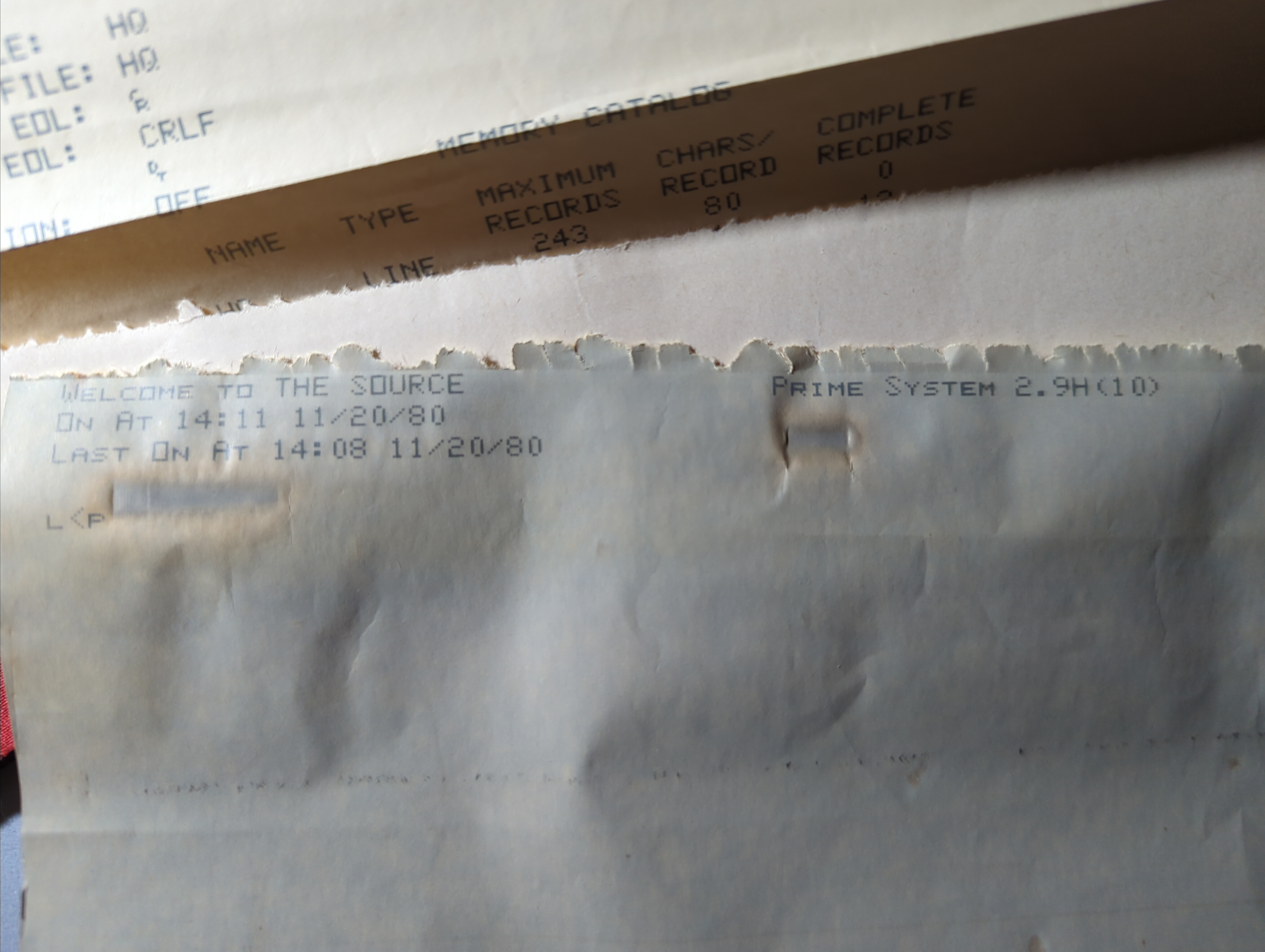
Tonight we're gonna log on like it's 1979 (Telenet, Dialcom and The Source)
Monday, March 28, 2022
prior-art-dept.: 5 letter words (Jim Butterfield's Jotto)

Friday, March 25, 2022
xa 2.3.13 and dxa 0.1.5
I've updated xa, André Fachat's venerable 6502 cross-assembler, to version 2.3.13, but also dxa, its companion disassembler based on Marko Mäkelä's d65, to version 0.1.5. I keep promising version 2.4, but somehow for years we never noticed that // and /* */ in quoted strings get improperly treated as comments instead of part of the string, and that seemed a pretty important bug to fix. A test case is now part of xa's fairly extensive regression analysis suite. 2.3.13 also includes patches for segfaults with parameter handling (but never run xa as root, kids, it kills kittens) and a miscellaneous correctness fix with null file handling. Although its development home platform remains AIX (with gcc) because I'm one of those people, and portability mumble mumble weird operating systems mumble endian, it is also tested and validated on Linux/ppc64le (gcc and clang), NetBSD/macppc and NetBSD/mac68k (gcc), and Mac OS X macOS (gcc on PowerPC, and clang on x86_64 and Apple silicon). Seriously, this is the last 2.3 release, dammit. No fooling. I mean it.
dxa's development was a little more colourful. This started with a file that didn't disassemble correctly (Paradoxon BASIC from 64'er, as it happens) because apparently d65 was never able to handle files that stretched riiiiiiiiiiiight up to the very last addressible byte ($ffff), let alone files that overflowed the addressing space or were bigger than 64K. However, even with that problem fixed, this particular test file also caused dxa to emit completely nonsense branches with unpossible displacements and even jumps to non-existent labels. This violates its core guarantee that you should be able to take dxa's output, feed it back into xa and get the binary you started with. It turns out that this is due to some weird C casts used for interpreting relative branches, so I made them more explicit, plus changes in the C preprocessor that caused the macro to check if a label exists to evaluate to true in one place and false in another. I think this file made a great test vector, so now dxa has a test suite too (make test; xa is naturally required) using it and a DOS wedge routine, and I'll probably throw in more exemplar code in the future. This new test suite is already earning its keep: it found a new bug when dxa is compiled with clang, which required even more reworking of the same section and some nearby code. Interestingly, even though now the test suite passes on all the same platforms as xa, dxa-built-with-clang generates subtly different output than dxa-built-with-gcc despite the fact the assembly files they both generate will yield bitwise identical binaries. Most of this seems to circulate around detecting vectors; clang flavour finds this in some places that gcc doesn't and vice versa. It's deterministic and predictable, but I'm not sure which one of them is "doing it right," so for now it'll be a curiosity until I can dig more into the differences.
Both xa and dxa are available under the GNU Public License v2.
Subscribe to:
Posts (Atom)