Saturday, January 15, 2022

prior-art-dept.: OWL Guide, early hypertext, and "replacing" the Web

I've been building up a few of these entries in my head as I run across things, so this will be the first of a recurring series of "prior art": technologies and ideas we use today that had earlier, different paths and implementations. For this inagural entry we'll be looking at OWL Guide, an early hypertext system for the Macintosh, and contrasting it with HTML and the modern Web.

Of course, hypertext didn't start with the microcomputer; one of the earliest document-oriented forms (as opposed to card- or frame-oriented like HyperCard or KMS, as well as other concepts) was the 1967 Hypertext Editing System, running on a partition on an IBM System/360 Model 50, contemporary with the baroque but much celebrated oN-Line System which formed the basis for the 1968 Mother of All Demos. However, the microcomputer was where it started to gain steam, with early text-only implementations like the DOS-based 1983 PhotoQuery, which became TIES in 1984. TIES' key innovation was advancing the convention that the text itself contained the links embedded within it, rather than navigating using external numbered menus, codes, icons or other gadgets. (TIES later evolved into HyperTIES, which in 1988 introduced early implementations of imagemaps and style sheets using its own "HTML" [HyperTIES Markup Language] for screen design, also based on SGML. HyperTIES was credited as the first instance where hyperlinks are blue.)

This was a natural fit for GUIs, and hypertext/hypermedia flourished on the early Macintosh. Naturally everyone remembers HyperCard and its various clones, the archetype (but not the prototype) of card-based hypermedia, but one of the earliest hypertext systems on any desktop computer was OWL Guide for the Mac, dating to 1986.

Saturday, December 25, 2021

Merry Old VCR Christmas

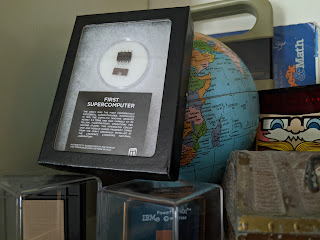
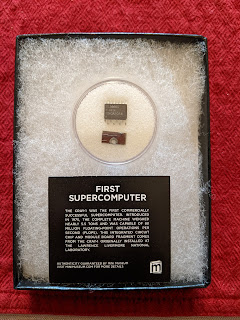
Signs you married well: your wife buys you vintage artifacts for Christmas, in this case a logic chip and fragment of a PCB from the Cray-1 at the Lawrence Livermore National Laboratory.
(The other chips in this picture are IBM dies from a 90MHz PowerPC 601+ and a POWER9.)

The chip is a Fairchild SL56660, a 5/4 NAND gate. The original design only employed four ICs but in huge quantities: this one, an alternative but slower NAND gate, 1Kx1 bipolar SRAMs (usually the Fairchild 10415FC, about 70,000 of them in the 1976 Los Alamos National Laboratory unit), and the specialized Fairchild SL82747. This chip bears a date code of 14th week 1981 and is based on emitter-coupled logic (ECL), making it very fast for the time but also very power-hungry; CMOS made ECL and MECL obsolete. The later date code can be attributed to the fact this was probably from a board installed for repair purposes.

Merry Christmas and a very happy holiday season.

Sunday, December 19, 2021

Monitoring the vintage server room (and reverse-engineering USB sensors)

We're house hunting because of $JOB and $HOUR hour commute, and I just got word that the reseller I contract with for Floodgap's leased line is getting out of that business in mid-January. This makes finding new digs (or at least setting up some sort of temporary static IP alternative) a must because one of the gotta-haves is space for my vintage server room. Sure, you can outsource, or host things on slices, or put things on a rack of Raspberry Pis and call it a day. And admittedly that would probably take up less space, generate less heat, use less power and result in less inconvenience, but where's the fun in that when you can be running your own 2008-vintage IBM POWER6 for mail, web and gopher, or a Sawtooth Power Mac G4 file server, or a 1989 Mac IIci that still happily handles internal network DNS?

Friday, November 26, 2021

xa 2.3.12

I've updated xa, André Fachat's venerable 6502 cross-assembler, to version 2.3.12. This contains a bug fix for a regression in 65816 mode which I'd meant to release earlier but got sidetracked on (thanks Samuel Falvo for the nice test case, which is also incorporated into the suite). As with prior versions it is tested on pretty much all of my Un*x-alike systems here including AIX, Mac OS X (PowerPC, Intel and Apple Silicon), NetBSD/mac68k and Linux/ppc64le. I said this before for 2.3.11 but one more time for the record: this will probably be the last in the exceptionally long-lived 2.3 series before 2.4, which as I keep warning you will definitely have some minor compatibility breaks and jettison a couple long-deprecated options and syntaxes (but will have some new features to make up for it). Again, more to come on that.

Sunday, October 3, 2021

Shiner ESB, an Apple Network Server prototype, and what it did at Netscape/MCom

The Apple Network Server was, with the possible exception of the Apple Workgroup Server 95, Apple's first true server. I have a particular soft spot for the ANS because it was also my first server: an ANS 500 ran Floodgap (even before Floodgap in 1998 as stockholm.ptloma.edu and gopher.ptloma.edu) from 2000 until 2012, and stockholm is still in my collection. While Apple had the Workgroup Server line, these were merely contemporary Mac designs with value-added software or hardware options, and as such ran Mac OS. (The AWS 95 ran A/UX, Apple's SVR2 Unix-System 7 hybrid, though it could also run Mac OS — being really a rebadged, hopped-up Quadra 950 — with its custom PDS SCSI card removed.)

The ANS, however, was a real honest to goodness server with hotswappable drive bays and fans, and (its most notable feature) an award-winning lockable translucent door so you could keep the unwashed masses out of your drives but still watch the blinkenlights. If you bought the bigger model, you even got dual power supplies and additional rear bays.

Also notable about the ANS was that they weren't supposed to run Mac OS, and were never sold with it, not least of which because the classic Mac OS wasn't really up to the task of being a server. Unfortunately, while A/UX supported larger needs on the 68K-based Workgroup Servers that could run it, A/UX 3 couldn't run on Power Macs even under emulation. The plan with A/UX 4 was to use a new PowerPC-native OSF/1-based kernel and possibly to also integrate portions of IBM's AIX operating system, but this plan (along with Taligent and other doomed projects) stalled out with everything else in Apple around that period. For a time Apple even considered using Novell NetWare on PowerPC; the port actually existed, codenamed Wormhole, but its tepid reception eventually led to the release of the weird Workgroup Server 9150 which just ran Mac OS. Eventually, to get to market Apple reached for what was then the only professional-level Un*x running on the new PowerPC architecture, which was AIX itself. Three Apple Network Server models were developed but only two (the "Low End" 500 and "High End" 700) were released; the 3U rack 300 "Deep Dish" remained solely a prototype, which I'd still love to acquire if its current owner ever gets tired of it. Oddly, even though they were only ever sold as AIX machines, they were initially demonstrated running Mac OS (possibly a custom version), further confusing potential customers who already didn't want to buy Workgroup Servers. Introduced in 1996 at a retail cost starting north of US$10,000, which didn't even include the AIX license, they were very poor sellers and the line was canned by Gil Amelio around a year later.

I got my ANS 500 barely used for the cost of some consulting work after Apple stopped supporting it; you can see some scanned Polaroids of when it was in production way back in 1998. Later, I acquired an ANS 700 which I use as a spare and was briefly in service while I diagnosed a hardware issue with the 500. More recently, however, I managed to land a Shiner HE prototype dated 1995 from a scrapper in San Rafael, California. That is the unit depicted in these pictures.

Tuesday, September 21, 2021

A happy ending (and future) for Plua

In my previous article on Plua, a port of Lua to classic PalmOS, I mentioned I was hopeful we'd have a happy ending where there was a clean-room implementation, or better still, that the original author would get in touch with me and we could redistribute it.

Well, I'm pleased to announce that Marcio himself did get in touch (he's got a lot of fun Palm and retro projects still underway, incidentally) and graciously consented to relicense Plua2c, the "cross-compiler" portion, under the same MIT license as Lua itself. You can now download the source code from Github, which I'll keep maintained.

As for Plua-the-Palm-app and its various components, I will still be hosting the .prcs on Plua Revisited indefinitely, and Marcio and I have been discussing how we can add some improvements such as expanded screen size support and the like. This means Plua has a future again, and I couldn't be happier. Thanks, Marcio!

Thursday, September 16, 2021

RIP Sir Clive Sinclair

In the US the name Sinclair is more associated with gas stations and partisan media outlets than computers. We had only the Timex Sinclair series States-side, of which the major models were the T/S 1000, a rebadged ZX-81, and the 2068, which was an upgraded but partially incompatible ZX Spectrum. (There was also the T/S 1500, a more upmarket version of the T/S 1000 roughly analogous to calling the Cimmaron by Cadillac a more upmarket Cavalier, and two minor non-American spinoffs of the T/S 2068, the TC2068 and UK2068.) These sold quite poorly in the United States because of the dominant position of the obviously superior Commodore 64 (I'm bracing for the comments from Martin), despite at least one retailer selling T/S 1000s at firesale prices so customers could get a rebate on a Commodore purchase. (Commodore reportedly used some of them for doorstops.) In the UK and Europe, however, they were a hit because they were cheap, and they introduced a generation to computers that may not have been able to afford them otherwise. My T/S 1000's keyboard has crapped out and I'm not even sure where my 2068 is, but on the announcement of Sir Clive Sinclair's death from cancer at 81, hats off, gentlemen, and godspeed.