And what are those supported platforms? Why, here's some of them as they were being cruelly whipped to perform like beaten dogs for your entertainment:

And what are those supported platforms? Why, here's some of them as they were being cruelly whipped to perform like beaten dogs for your entertainment:
Let this paragraph represent a right to use, distribute, modify, enhance, and otherwise make available in a nonexclusive manner CP/M and its derivatives. This right comes from the company, DRDOS, Inc.'s purchase of Digital Research, the company and all assets, dating back to the mid-1990's. DRDOS, Inc. and I, Bryan Sparks, President of DRDOS, Inc. as its representative, is the owner of CP/M and the successor in interest of Digital Research assets.This was to clear up an apparent earlier misunderstanding that Sparks' earlier open release of CP/M in 2001 was restricted to distribution via a particular site. Sparks clarified this was not his intent.
Overall, would I prefer a more conventional open-source license? Sure. But he didn't have to do this then, he didn't have to do this now, and he did. So, thanks, Bryan.
However, because QEMU is a much lower-level emulator, that means that things like mice are also emulated, and that tends to chug a bit even with QEMU's JIT (currently KVM-PR, the virtualization system for Power ISA, does not work properly with Mac OS 9 in QEMU for reasons that have not yet been determined). If you use the default mouse support, the mouse is entirely maintained by the operating system and the polling frequency is just slow enough to be frustrating, and you have to grab and ungrab it all the time. The normal solution is to use an absolute pointing device like the QEMU tablet and solve all these problems at once, but the classic Mac OS doesn't support it and the existing Wacom driver doesn't work. (SheepSforza, on the other hand, hooks the system mouse and system mouse pointer into the guest OS, so it's much more responsive and transparent if I do say so myself.)
To support this and other QEMU virtual devices requires updating the guest Mac. And, happily, there are now two approaches at least for doing so for the QEMU tablet, which make an interesting comparison on how we could get other devices supported on the classic Mac OS.
Markdown circa 2004 has displaced most of the others today, but it explicitly never claimed to be the first such human-readable format; indeed, AsciiDoc predates it by about two years, reStructuredText a year before that and MakeDoc about a year before that. For that matter, some of the concepts popularized in Markdown might not have existed at all were it not for earlier ancestors like 2002's Textile.
But a forgotten rich text language predates most of these, with the interesting property in that much of the markup is encoded using trailing whitespace, almost a fusion of in-band and out-of-band styling systems. If the whitespace is munged, it's largely just a text document (like those particular Mac files if you pass along only the data fork); but if it passes through intact, an intelligent converter can use attributes encoded in the whitespace to style it into HTML. That system is ProleText.
T1 lines have never been cheap, though back in the day they were prized because at 1.536 Mbit/s each way they were comparatively high capacity. At my first job out of college in 1997 the university had a T1 connected to an AdTran CSU/DSU, adding more T1 lines on and bonding them for additional bandwidth until they upgraded to optical fiber. A friend of mine in the very late 1990s had his own residential T1 (this was when consumer DSL was uncommon and 56K dialup was still frequent) that his employer paid the bill for, reportedly close to a cool grand a month in those days; he would never been able to afford it otherwise. On a cost basis alone (and certainly dollars per megabit) a T1 would have been far from my first choice, but I needed a reliable server-grade connection and I couldn't find any other alternatives at the time, so if I wanted to get my hardware back online from the house I was going to have to pay up and get one. Rather than use the actual telephone company I went with an overlay vendor and was quoted $295 a month on an annual contract for a 16-address netblock plus $199 installation. Now going into my fourth week of downtime, I signed immediately. They called the telco who came out the next week, installed the smartjack (we'll talk about what this is), took over both telephone wire pairs to the house and wired it into the pedestal — conveniently, the local telco pedestal is literally in my backyard. Good thing I'd already moved the house alarm modem to a wireless connection since I could no longer have a landline now. I then ran lines from the smartjack into the server room (thanks to the telephone guys I used to work next to when I was consulting I already had good experience with a punchdown tool), the vendor came out the week after that with the T1 router, and finally Floodgap was back up.
The original idea was to use the T1 until something less expensive came along, but the T1 just plain worked and was always highest priority on service calls, so inertia and inflation eventually turned the $295 a month into $399 and a 12-month contract into 48. Still, it was a tariffed line with a service-level agreement, I had plenty of addresses and my personal bandwidth requirements have always been modest — I don't cloud, I rarely stream and YouTube is worse than television — so I ended up just using the T1 as my personal ISP at the same time and avoiding a second bill. This worked out fine for awhile except, of course, for love. My wife needed her Netflix and her iCloud, and by then the previously intransigent cable provider had been bought by someone else (fiber? hahahaha) who didn't know any of the previous history; they came out and finally pulled an RG-6 cable run five years after the fact, and switched us on. I moved the Wi-Fi to the new cable net and her bandwidth needs were thus met in the manner to which she was accustomed. We joke about the his'n'hers networks: I still had my lab and servers on the T1, and everything else including her devices was on the cable.
Well, it was good we did that because I mentioned in January this year that the vendor (which had changed owners twice over the years) was abruptly getting out of the residential T1 business and I had a month before it was switched off. I may well have been their last customer in the region. So I'd like to publicly thank John who reached out and offered a no-strings VPN arrangement — which I'm routing over the cable — to keep Floodgap online while we consider our housing options in a market as bad as it was good when I first bought the place. We turned the VPN on and the vendor turned the T1 off. They never asked for the router back and the smartjack still sits in the back of the house.
Now it's Memorial Day in the United States and I suppose I'll have to do something about that now superfluous wiring run sometime soon. Before I do, though, let's document the T1 for a generation who may have never seen one ... and figure out something fun to do with the router they left behind other than, you know, routing stuff.
Like every computing story, this one begins with a box.

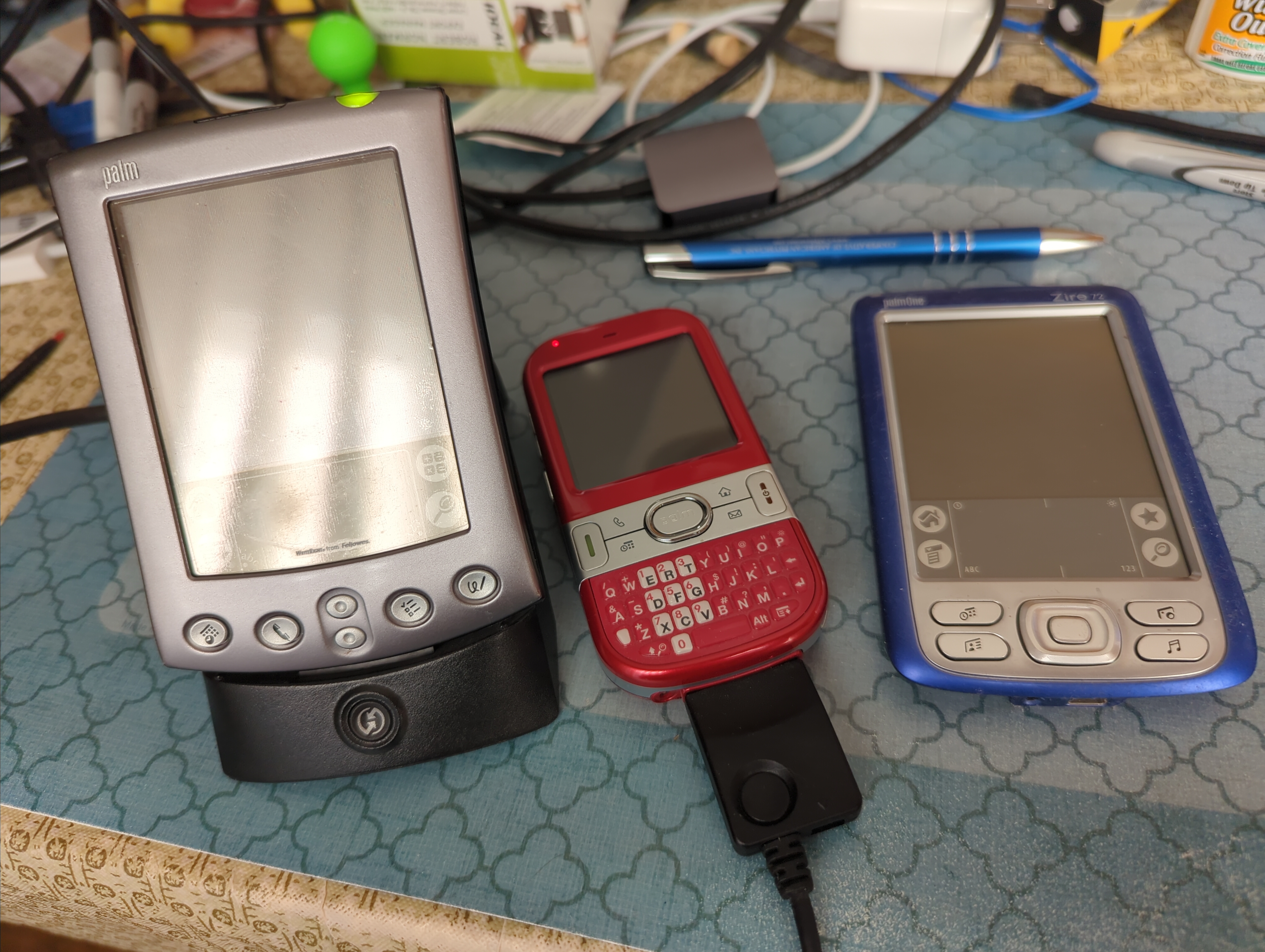
In 2004 I was working on a gopher client for my Palm m505, written in Lua using the new hotness of Plua 1.x, which supported UI, graphics and networking built-in. I christened an early implementation as "Port-A-Goph" and it even got a mention in Wired. Due to socket bugs in that version that never got fixed, I deferred the release until I could rewrite Port-A-Goph for Plua 2. Over the next few years I worked on it intermittently but got distracted by other projects, and eventually after moved to iOS and then Android I stopped carrying a Palm around with me entirely. Since I have my own Gopher client on Android, the PalmOS version sat in suspended animation.
Well, it's time to dust off the resurrected Port-A-Goph, newly christened into the Overbite client family as Overbite Palm. Along the way we'll make sure it works on a selection of real hardware: