Showing posts with label refurb weekend. Show all posts

Saturday, February 7, 2026

The Scriptovision Super Micro Script video titler is almost a home computer

Canadians, rejoice! Not only do you have curling, the Big Turk and Tim Hortons (and, when I was in BC last, Dr Pepper made with real cane sugar), you also have a number of interesting indigenous computers like the underappreciated Micro Computer Machines MCM/70 portable, the Tarot Electronics MIMIC (not to be confused with the more notorious Spartan Mimic), the Dynalogic Hyperion and of course the NABU Personal Computer. And, like your neighbours to the south, you have terminals too, most notably the Telidon and Alextel.

Terminals, however, are in many cases based on general purpose architectures, just lashed to restrictive firmware — a good example would be the DEC VT220 which is controlled by our old friend the Intel 8051 — and game consoles likewise fall naturally in this category. Plus, there's a third group of computer-adjacent devices that qualify as well: the video titlers.

Video titlers (also known as character generators) are exactly what they sound like: devices that stamp bitmap data, usually text, on top of a video signal, like this typical example from a 1992 demo video for the consumer-oriented Videonics Video Titler. Distinct from what you might do as part of an editing system, many of these machines operate in real-time and over live video input such as the classic Chyron systems. Today's titlers are usually add-on boards controlled by a standard desktop computer, but for much of their existence they came as standalone devices with their own CPUs and video hardware, and that means they can be potentially hardware-hacked like anything else.

Well, Canada, you have your own indigenous video titlers as well, and here's one designed and manufactured in beautiful Montréal: the Scriptovision Super Micro Script, circa 1985.

The Super Micro Script was one of several such machines this company made over its lifetime, a stylish self-contained box capable of emitting a 32x16 small or 10x4 large character layer with 64x32 block graphics in eight colours. It could even directly overlay its output over a composite video signal using a built-in genlock, one of the earliest such consumer units to do so. Crack this unit open, however, and you'll find the show controlled by an off-the-shelf Motorola 6800-family microcontroller and a Motorola 6847 VDG video chip, making it a relative of contemporary 1980s home computers that sometimes used nearly exactly the same architecture.

More important than that, though, it has socketed EPROMs we can theoretically pull and substitute with our own — though we'll have to figure out why the ROMs look like nonsense, and there's also the small matter of this unit failing to generate a picture. Nevertheless, when we're done, another homegrown Canadian computer will rise and shine. We'll even add a bitbanged serial port and write a MAME emulation driver for it so we can develop software quickly ... after we fix it first.

Sunday, January 25, 2026

Hands-on with two Apple Network Server prototype ROMs

Grateful acknowledgement made to the several former Apple employees who materially contributed to this entry. This article wouldn't have been possible without you!

Here's why I need to do inventory more often.

This is an Apple prototype ROM I am ashamed to admit I found in my own box of junk from various Apple Network Server parts someone at Apple Austin sent me in 2003. The 1996 Apple Network Server is one of Apple's more noteworthy white elephants and, to date, the last non-Macintosh computer (iOS devices notwithstanding) to come from Cupertino. Best known for being about the size of a generous dorm fridge and officially only running AIX 4.1, IBM's proprietary Unix for Power ISA, its complicated history is a microcosm of some of Apple's strangest days during the mid-1990s. At $10,000+ a pop (in 2026 dollars over $20,700), not counting the AIX license, they sold poorly and were among the first products on the chopping block when Steve Jobs returned in 1997.

stockholm, my own Apple Network Server 500, was a castoff I got in 1998 — practically new — when the University bookstore's vendor wouldn't support the hardware and it got surplused. It was the first Unix server I ever owned personally, over the years I ended up installing nearly every available upgrade, and it ran Floodgap.com just about nonstop until I replaced it with a POWER6 in 2012 (for which it still functions as an emergency reserve). Plus, as the University was still running RS/6000 systems back then, I had ready access to tons of AIX software which the ANS ran flawlessly. It remains one of the jewels of my collection.

So when the mythical ANS MacOS ROM finally surfaced, I was very interested. There had always been interest in getting the ANS to run MacOS back in the day (I remember wasting an afternoon trying with a Mac OS 8 CD) and it was a poorly-kept secret that at various points in its development it could, given its hardware basis as a heavily modified Power Macintosh 9500. Apple itself perceived this interest, even demonstrating it with Mac OS prior to its release, and leading then-CTO Ellen Hancock to later announce that the ANS would get ROM upgrades to allow it to run both regular Mac OS and, in a shock to the industry, Windows NT. This would have made the ANS the first and only Apple machine ever sold to support it.

Well, guess what. This is that pre-production ROM Apple originally used to demonstrate Mac OS, and another individual has stepped up with the NT ROMs which are also now in my possession. However, at that time it wasn't clear what the prototype ROM stick was — just a whole bunch of flash chips on a Power Mac ROM DIMM which my Apple contacts tell me was used to develop many other machines at the time — and there was no way I was sticking it into my beloved production 500. But we have a solution for that. Network Servers came in three sizes: the rackmount ANS 300 ("Deep Dish") which was never released except for a small number of prototypes, the baseline ANS 500 ("Shiner LE"), and the highest tier ANS 700 ("Shiner HE") which added more drive bays and redundant, hot-swappable power supplies.

Which brings us to this machine.

Meet holmstock, my Network Server 700, and the second ANS in my collection (the third is my non-functional Shiner ESB prototype). This was a ship of Theseus that my friend CB and I assembled out of two partially working but rather thrashed 700s we got for "come and get them" in August 2003. It served as stockholm's body double for a number of years until stockholm was retired and holmstock went into cold storage as a holding bay for spare parts. This makes it the perfect system to try a dodgy ROM in.

I'll give you a spoiler now: it turns out the NT ROM isn't enough to install Windows NT by itself, even though it has some interesting attributes. Sadly this was not unexpected. But the pre-production ROM does work to boot Mac OS, albeit with apparent bugs and an injection of extra hardware. Let's get the 700 running again (call it a Refurb Weekend) and show the process.

Saturday, September 13, 2025

Refurb weekend: Silicon Graphics Indigo² IMPACT 10000

It's one of my periodic downsizing cycles, which means checking the hardware inventory (and, intermittently, discovering things that were not on the hardware inventory) and deciding if I want to use it, store it or junk it. And so we come to this machine, which has been sitting in the lab as a practical objet d'art when I picked it up from a fellow collector for the cost of take-it-away almost exactly a decade ago.
This beautiful purple slab is the Silicon Graphics Indigo² (though, unlike its earlier namesake, not actually indigo coloured) with the upper-tier MIPS R10000 CPU and IMPACT graphics. My recollection was that it worked at the time, but I couldn't remember if it booted, and of course that was no guarantee that it could still power on. If this machine is to stay working and in the collection, we're gonna need a Refurb Weekend.

Saturday, June 28, 2025

Refurb weekend: Gremlin Blasto arcade board

Because my sisters were taking rollerskating lessons and my own rink skills mostly consisted of pratfalling, my mother would occasionally give me quarters for the arcade instead. This was my first introduction to pinball — one of these days I'll have room for my first pin, a Williams Pin-Bot, alongside my Sopranos and ST:TNG machines — and quite a few arcade video games that I later got to play on my Tomy Tutor, Commodore 64 and Intellivision at home.

However, a few games I played on the Tutor first before I ever played them on an arcade cabinet (Pooyan and Loco-Motion come to mind), and one outlier I never played in the arcade at all. Earlier, when we briefly lived in the Antelope Valley north of Los Angeles, the first computer I got to ever touch (albeit briefly) was a Texas Instruments 99/4A in the third grade classroom. Among other cartridges it had a brisk and zippy arcade conversion called Blasto from Milton Bradley which never got ported to any other system, and it wasn't until after college that I reacquainted myself with the TI version in emulation. I never actually got to put quarters in one.

A shame, because by then we lived on the mean streets of east county San Diego, California — not far, it turns out, from the corporate office of Gremlin Industries where the original arcade incarnation of Blasto was developed (completely unrelated to the later PlayStation game). I spent most of my childhood and got my bachelor's degree in San Diego, and I still consider it my hometown. Decades later I managed to pick up an original service manual for yuks last year, which sat mostly pristine in my collection, but much more recently an actual Blasto logic board based on an 8080A CPU turned up on eBay.
After waiting awhile for the seller to cut the crap, they finally posted it at a not totally unreasonable price for a completely untested item, as-was, no returns, with no power supply, no wiring harness and no auxiliary daughterboards. At the end of this article, we'll have it fully playable and wired up to a standard ATX power supply, a composite monitor and off-the-shelf Atari joysticks, and because this board was used for other related games from that era, the process should work with only minor changes on other contemporary Gremlin arcade classics like Blockade, Hustle and Comotion [sic]. It's time for a Refurb Weekend.

Saturday, January 4, 2025

Refurb weekend: Atari Stacy

Ask any Atari Stacy owner how to open an Atari Stacy and the answer is always "never, if you can avoid it." So I'll just lead with this spoiler image after the refurb to prove this particular escapade didn't completely end in tragedy:
Stacys are horrible machines to work on. Nobody likes being inside of one. The daughterboards don't have keyed connectors (including the power supply!) and are constantly attempting to come free, the display "cable" is actually a Medusa's wig of wires that like to short (!), the top case is a huge bulky sheet of increasingly fragile plastic that somehow has to fit around the floppy drive yet down on the keyboard simultaneously, and the entire laptop is an uneasy sandwich held together by a small set of screws in plastic races that strip and fracture with little provocation. So why do we tolerate this very bad, bad, bad, bad girl? Because most of us will never see the much lighter and streamlined STBook in the flesh, let alone own one. If you really want a portable all-in-one Atari ST system, the Stacy is likely the best you're gonna do.

And we're going to make it worse, because this is the lowest-binned Stacy with the base 1MB of memory. I want to put the full 4MB the hardware supports in it to expand its operating system choices. It turns out that's much harder to do than I ever expected, making repairing its bad left mouse button while we're in there almost incidental — let's just say the process eventually involved cutting sheet metal. I'm not entirely happy with the end result but it's got 4MB, it's back together and it boots. Grit your teeth while we do a post-mortem on this really rough Refurb Weekend.

Sunday, October 13, 2024

Refurb weekend: the Symbolics MacIvory Lisp machine I have hated

Every collector has that machine, the machine they sunk so much time and, often, money into that they would have defenestrated it years ago except for all the aforementioned time and money. Yours truly is no exception.
That machine is my first Lisp Machine and my only one actually using real Lisp Machine hardware, this Symbolics MacIvory III in a Macintosh IIci host. To date it's cost me over $6000 total, primarily its initial purchase price, but also to rehabilitate it and just keep it alive. That's nearly as much as what I paid out of pocket for my $7300 (in 2018) POWER9 Raptor Talos II Linux workstation and my $10,000+ IBM POWER6 server, which I acquired in 2010 and in 2024 dollars would be over $14,000 — and both of those machines have been substantially less troublesome.

For those of you unfamiliar with the general world of Lisp machines, they are, as their name implies, workstations entirely designed around the Lisp programming language. That doesn't just mean using conventional processors with a Lisp runtime either: these devices are built to run Lisp from the silicon up with specific hardware support. (Some of these systems could also run Prolog, my personal favourite AI-adjacent language. We'll play with a surprising small Prolog implementation in a future article.) They existed in highly technical environments as workhorses of the first wave of AI hysteria (you crazy kids today with your LLMs) for applications like natural language processing and expert systems. The genre more-or-less flourished from the end of the 1970s to the early 1990s and included some of the first systems to implement advances like bitmapped displays, networking and pointer devices. In turn, those unusual capabilities caused them to also develop distinctive user interfaces for their unique feature set, years before today's GUI and keyboard conventions we almost unconsciously take for granted were even conceived of. Working with a Lisp machine can be a remarkably different user experience from modern computing and the occasionally jarring nature of those differences isn't something present-day emulators fully capture.

Unfortunately, their rarity also makes them the whitest of white elephants sometimes. Besides what I had to do to get it working properly to start with, the hard drive started timing out and it randomly froze during boot or shortly afterwards. (There was also the matter of me never finishing its setup, let alone getting it networked.) I'm not letting this benighted thing die on me after all I've put into it — it's time for a Refurb Weekend.

Monday, May 27, 2024

Refurb weekend: Canon Cat

It's the Memorial Day holiday weekend and it's time for a little deferred maintenance, especially on those machines I intend to work on more in the near future. So we'll start with one that's widely considered to be a remarkable cul-de-sac in computing history: the Canon Cat.
Many people take a casual glance at this machine and say, "Isn't that an overgrown word processor?" And one could certainly think so, in part because of its keyboard-centric operation, but mostly from the utterly uncomprehending way Canon advertised it in 1987. Canon dubbed the Cat a "work processor" because of its built-in telecommunications, modem and word processor even though Jef Raskin, its designer, had intended it as a "people's computer" that could be inexpensive, accessible and fully functional — all things he had hoped to accomplish at Apple after first launching the Macintosh project, prior to departing in 1982.

Canon, however, never fully grasped the concept either. Apart from the tone-deaf marketing, Canon sold the device through their typewriter division and required the display to only show what a daisywheel printer could generate, limiting its potential as a general purpose workstation. There was also an infamous story where Canon engineers added a hard power switch not present in the original prototype, believing its absence to be an oversight — over Raskin's objections, who intended the machine as an always-on, instantly useable system. The Cat nevertheless launched at an MSRP of $1495 ($4125 in 2024 dollars) in July that year to many plaudits and design awards, but alleged corporate shenanigans and uncertainty within Canon doomed it internally, causing them to dropkick the product after just six months and 20,000 sales. In the wake of the 1987 Black Monday stock market crash Raskin's investors subsequently pulled the plug and the company closed in 1991.

But what was actually under the hood was a unique all-in-one 68000 machine with a bitmapped display and a full Forth environment hidden in its ROM-based, fast-start operating system. There's no hard disk, just a single 3.5" floppy drive to save your documents and the current Forth dictionary. Although the default mode is the built-in word processor, its tForth ("token-threaded Forth") dialect was easily unlockable and Information Appliance, Inc., Raskin's company that produced the Cat and licensed it to Canon, published substantial documentation on how to enable and program in it.

We'll have more to say about that in a future entry when we get into the guts of the OS. Today, we have two tasks: replace its settings battery and shore up the nearly unobtainium custom Canon floppy drive, its most common point of failure. It's time for a Refurb Weekend.

Saturday, March 30, 2024

Refurb weekend: Data General/One (and the worst LCD in the world)

I mentioned earlier that while I prefer specializing in non-x86 laptops, that doesn't mean I don't collect interesting or unusual x86 laptops, like the Brother GeoBook NB-60 (I finally tracked down a mostly working NB-80C, the top of the line model, which will be the subject of a future restoration). However, this one is a unit I've had since about 1998 when they were getting rid of it at the University I worked for, and in many ways a landmark PC laptop since it was the first battery-capable system with a full 80x25 or CGA 640x200 LCD — though with a notorious deficiency: more on that shortly — and also came with a terminal and text editor in ROM. This is the 1984 Data General/One.
I suspect it was primarily used to dial into the campus network using the built-in modem and ROM terminal emulator, at least until better alternatives became available, and then ended up forgotten somewhere until they were cleaning things out and asked me if I wanted it. (Yes, I was retro even before retro.) It came with its bag, power supply and modem cable, and of course I said yes. It wasn't pristine, though: the floppy disk eject buttons wouldn't stay on anymore, it couldn't remember its hardware configuration, and the main drive had issues with nearly full disks. And then there was that infamous LCD.

Ah, what the heck. I finally got a round tuit. That makes it time for ... another Refurb Weekend.

Saturday, September 2, 2023

Refurb weekend: PowerBook Duo 2300c

Ah, the last and mightiest of Apple trying to have it both ways: the 1995 PowerBook Duo 2300c, and the only PowerPC laptop in the entire series before Apple canned the line in 1997. It had the Duos' biggest screen, the most memory and disk space, and the fastest CPU of all, yet crammed everything into a 9.5" 640x480 display and an 88% keyboard that feels like typing on a bouncy castle.

But being Apple's smallest laptop — even today the Duos are still the fourth smallest, width-height-wise — wasn't the (main) point of the Duos. Arguably, the main point was the Dock. Even Jerry Seinfeld had one.

With the Dock, your little, relatively underpowered laptop was hoovered up into a beige plastic maw to make it into an average-sized, somewhat less underpowered desktop. But you got slots and ports and the ability to use it like a desktop computer — two computers in one! — and that was crucial because without any Dock, even the smaller Mini and MicroDocks, you had hardly any ports at all (MacBook Air has entered the chat). Docking was so important that Apple even intentionally gimped the 2300 by keeping the 100MHz 603e on a 32-bit bus to maintain Dock compatibility. Yet because Duos were irrepressibly cute, they turned up in many other TV shows and even movies, most notoriously Hackers:
(People hate on Kate Libby's offhand comment that it has the new "P6 chip" especially when the trackball gives it away as a 68K Duo, but allegedly the unit in the film had a 2300 logic board, Apple did call the 60x series "P6" in some marketing material, and the "28.8 bps" [sic] modem did at least exist as a prototype. The greater technical sin is Dade Murphy saying it has a PCI bus even though no Duo ever did; the first PowerBook to be PCI was the 3400.)
Unfortunately, one of my two 2300c systems is showing evidence of the same problem that ruined the front of my favourite PowerBook 1400: the metal hinges are starting to tear out of their attachment points in the plastic back of the display, and naturally it's the one with all the upgrades in it. The most common symptom, besides bulging or split hinges when the display is closed at the point where the back and front come together, is the bottom front bezel cracking from the strain as you open it. If you learn one thing from this blog post, when opening pre-G3 PowerBooks, place your thumbs on each side of the bottom bezel of the display as you open them to support the hinge attachments. It's time for a Refurb Weekend.

Friday, September 1, 2023

Adding a cooling fan to the Commodore 128DCR

Call it a "refurb weekend sequel" to our previous work on my beloved Commodore 128DCR. It's been a hot, horrid summer in Floodgap Very Sub-Orbital Headquarters and I was somewhat concerned about the heat in the house computer lab even with the A/C cranked up to "Vegas weekend for Southern California Edison's Board of Directors" levels. But it's even worse for cooling when your one and only rear vent looks like this:
(No, I don't know what spilled there either.) The European plastic-case 128D (not this metal-cased "D Cost Reduced") has a cooling fan — and I recently landed an Australian one, more on that later — but as part of becoming CR the fan was eliminated, relying entirely on that vent and whatever warm air comes out of the rear ports to save the 8502 from being "well done." Fortunately Commodore determined it was also too much C to remove the mounting holes, so let's put in a fan instead of hoping the convection cooling is good enough.

Friday, July 7, 2023

Refurb weekend(s): Commodore/MOS KIM-1

Actually, it was more like a whole stinking Refurb Two Months. The KIM-1 is one of the earliest MOS 6502 computers, a single-board system with 1K of RAM (actually 1152 bytes total) and a one-megahertz CPU developed by Chuck Peddle in 1975 as a way to introduce engineers to the new 8-bit microprocessor. However, its low cost meant it ended up taking on a life of its own as it was one of the cheapest ways to assemble an entire working hobbyist system, and Commodore continued to sell them for several years after they bought MOS. You could hand-key in programs with the hexadecimal keypad and the six LEDs as a display or wire up a TTY. It also supported saving and loading from cassette and paper tape, all built-in to the standard ROMs.

I have a couple KIM-1s and they are the oldest machines in my personal collection, including a Revision A pre-Commodore MOS unit with ceramic processor and RRIOTs, but the one that's the most special to me is the briefcase Revision D system you've seen here in other entries. The Revision D is notable historically as the first Commodore-branded KIM after their 1976 buyout, but it's important to me because this unit was my first KIM, and the one we got in high school from our high school math teacher and learned to program it over the weekend (we'd grown up with the Commodore 64, so we already knew all the machine language opcodes). It conveniently sits in a briefcase with a power supply and has one of Bob Applegate (RIP)'s I/O boards to provide the RS-232 connection.

While working on our most recent KIM-1 project, I noticed that the RAM from $0280 to $02bf wasn't working right. The serial uploads from KIMup would succeed, but the data it stored in that range was wrong, and when I checked with the monitor it would only store values 0-3. I got around the problem by assembling the code to a different address, but on a system with a single kilobyte of memory, you can't ignore a whole 32-byte failure. It was time for a Refurb Weekend.

Tuesday, May 30, 2023

Refurb weekend: Commodore 128DCR

No question: the Commodore 128D is the finest Commodore 8-bit ever made. On this I tolerate no dissent, and that's not just because I sometimes hang out with Bil Herd. It's a 128, so it's got VDC graphics, 128K and 2MHz operation, but because it's a 128 it's also a 64. It's also an upgraded 128 with the fixed ROMs, (in this North American 128DCR) 8568 VDC and 64K of VDC memory, it's got a built-in 1571 (Commodore's finest 5.25" disk drive), and it doesn't have an external power brick. Plus, even though it has the desktop footprint of a 128, the detachable keyboard means you can just put a monitor on top of it (and the steel-cased North American 128DCR handles that very well) just like you can't with a flat 128, and you either get an actual cooling fan with the plastic 128D or the solder points to put one in a steel 128DCR. My only complaint is that the consolidated DCR motherboard is nearly devoid of socketed ICs, making it a little tough to do component level repair on. I like spares, so I have four DCRs, all of which completely or mostly work (and two spare keyboards, one rather yellow but fully functional and one even more yellow and useful just for parts).

This particular 128DCR has been a constant presence on my desk since the mid-1990s when I first got it as an upgrade from my ailing flat 128. But it has one flaw: it doesn't have a working CIA Time-of-Day clock, which isn't used much by software, so I never bothered to do anything about it. This was tricky when developing TOTP-C64, since the 30 second timer between emitting TOTP codes uses the TOD clock for maximum interval accuracy (the 50/60Hz Timer A interrupt that drives the TI/TI$ jiffy clock can be stalled and lose time, whereas the TOD clock is based on the AC mains frequency and thus is as accurate as your plugged-in wall clock); one of my portable SX-64 systems, my second favourite Commodore 8-bit, handled that portion of testing instead.

Well, now that I've got a new Ultimate II+L cartridge in fire-engine red with its own real-time clock (among other great features), I'd like to update TOTP-C64 to support it and I'd rather do it on the 128DCR. That means we should fix the TOD clock. And that means ... a Refurb Weekend!

Friday, March 31, 2023

Refurb weekend: DEC AlphaPC 164LX

It's time for another Crypto Ancienne checkpoint, which will be a post Real Soon Now(tm), including some new operating system frontiers. But part of the work for Cryanc is all the build regression testing on the supported platforms: each of the platforms I vouch for has to be able to compile the updated source code and use carl, its built-in mini-curl clone (officially the "useful" demonstration application), to successfully and completely download from a selection of real websites. One of these is harlan (named for Harlan Anderson, co-founder of Digital Equipment Corporation), my one and only DEC Alpha-based machine, a DEC AlphaPC 164LX running Digital UNIX Tru64.

The DEC Alpha is a good test for Crypto Ancienne because it's a fast (for the time) and finicky (for all time) RISC architecture, with notoriously strict alignment requirements and an extremely loose memory model. Early Alpha CPUs in fact entirely lacked instructions for direct short or byte access — 32-bit, 64-bit or bust. Unfortunately the Ethernet card blew while I was testing Cryanc 2.0 and I couldn't validate that version, so I just pushed that checkpoint out the door. Well, we can't do that two releases in a row, darn it. I have a replacement NIC and a mission. It's time for a Refurb Weekend.

Saturday, March 4, 2023

Refurb weekend: Cobalt RaQ 2

In the post on our recently resurrected fork of Dreamcast Linux, I mentioned the NetBSD NFS server providing basically all of its persistent storage. A few days into the development work I started hearing a weird whine coming from the server room and sure enough the NFS server had a bad fan — in fact, the only fan cooling the entire 1U system. That means it's time ... for another Refurb Weekend!

Sunday, November 27, 2022

Refurb weekend: Sega Dreamcast

Remember when consoles weren't glorified PCs? The 1999 Sega Dreamcast remembers. Sega's final console and introduced on "9/9/99 for $199" before the Sony PlayStation 2 hype machine overwhelmed it, it came on the heels of the Saturn, which had sophisticated hardware but was difficult to program and Sega lost millions on manufacturing them. In some ways the Dreamcast is the Saturn done right: the same SuperH architecture, just way faster (instead of dual SH-2s at 28.6MHz, one big SH-4 at 200MHz), a more conventional GPU (rather than the odd 3D VDP of the Saturn which used quads instead of triangles), and a straightforward uniprocessor design instead of the Saturn's sometimes rickety dual CPU bus. It was also much cheaper to manufacture even considering its use of the Yamaha GD-ROM format; nothing else supported it, but it stored up to a gigabyte and was backwards compatible with CDs.

However, the Dreamcast was also not very future-proofed as it was the only fifth-generation console not to use DVD format (even the "mini" discs of the GameCube stored more), and Sega's attempt to outrun Sony and Nintendo's new offerings with deep discounts only served to make the console unprofitable faster. Sega announced the discontinuation of the Dreamcast on March 31, 2001, and slashed the cost to $99. I'd heard good things about it, I'd played Crazy Taxi in the arcades, and there it was at Fry's (rest in peace) at a price I could afford as a starving student, so I picked one up. Games turned up in quantity at lower prices and I even managed to land a Broadband Adapter and a keyboard and a light gun and a mouse and the Seaman microphone and even the fishing reel controller. There's also an SD card reader plugged into the back expansion port I can play disk images off.

Although I've picked up a couple other Dreamcast and Dreamcast-adjacent systems since, I still have the original one in my office. Its internal battery used for storing settings had long since worn out, requiring me to enter the date and time every time I wanted to play a game, but then it wouldn't read any discs other than SoulCaliber. I mean, I like SoulCaliber, but this was ridiculous. No Crazy Taxi? It's time for ... a Refurb Weekend!

... after we play a game of SoulCaliber.

Saturday, November 5, 2022

Refurb weekend: Commodore SFD-1001

The Commodore SFD-1001 is an oddball and a rarity even among Commodore IEEE-488 5.25" floppy drives, which nowadays aren't particularly common either (though my preferred IEEE-488 device is the MSD Super Disk Drive SD-2, which also conveniently has IEC serial). The SFD "Super Floppy Drive"-1001 is a low-profile single drive version of the CBM 8250 dual drive and stores a whopping 1MB per disk, which when the series was introduced in 1980 was really quite something. Unfortunately it requires 96tpi double density "quad density" floppies to do it — not the 48tpi double density disks you'd feed a more typical 1541 or 1571, nor the 96tpi high density PC floppy drives use — so there wasn't a whole lot of megabytes to store into even when these drives were newer. I also have a CBM 8050 which is the single-sided (but still dual drive) version of the 8250; it can store roughly a cool meg too but you have to flip it over for the second half.

This SFD came to me from a seller who said while it powered on it also made a weird noise and he had trouble inserting disks. Nevertheless, it's still an odd enough duck it was worth buying to see if it was repairable. We have an extra hour this weekend from the daylight savings change, so let's crack this sucker open.

Friday, October 21, 2022

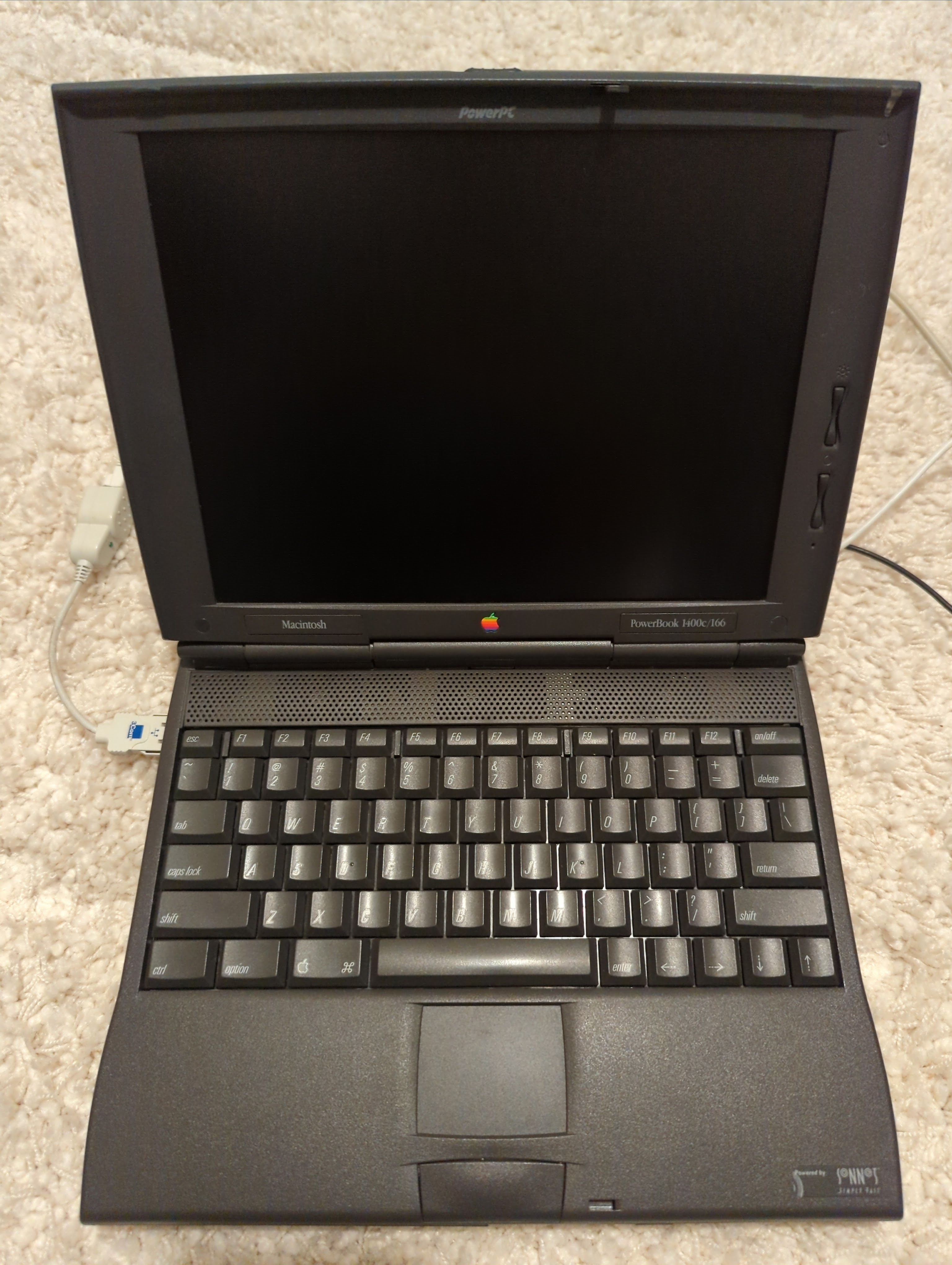
Refurb weekend: PowerBook 1400

The PowerBook 1400 is, and remains, my favourite laptop. It was everything the PowerBook 5300 should have been and more. It was my first laptop, too, a hand-me-down from my sister's then-husband in 2001-ish who said if I could fix it, I could have it (a 1400cs/117 with a 117MHz PowerPC 603e). Only about four years old at that point, it turned out to need a new inverter board and a LCD, so I just bought it a new entire top half and installed it myself. I named it Benji. It ended up as my sole portable computer until I upgraded to a 12" 1.2GHz iBook G4 several years later.

It's that modularity (plus an exceptional keyboard) that makes the 1400 a particularly wonderful machine: over time I added a Sonnet 333MHz G3, extra RAM (the cs supports up to 60MB), a Apple 8-bit external video card and a 3Com EtherLink III PCMCIA NIC (which I hacked up a driver for), all on top of the 56K modem he installed and the floppy disk and CD-ROM drive bay modules it came with.

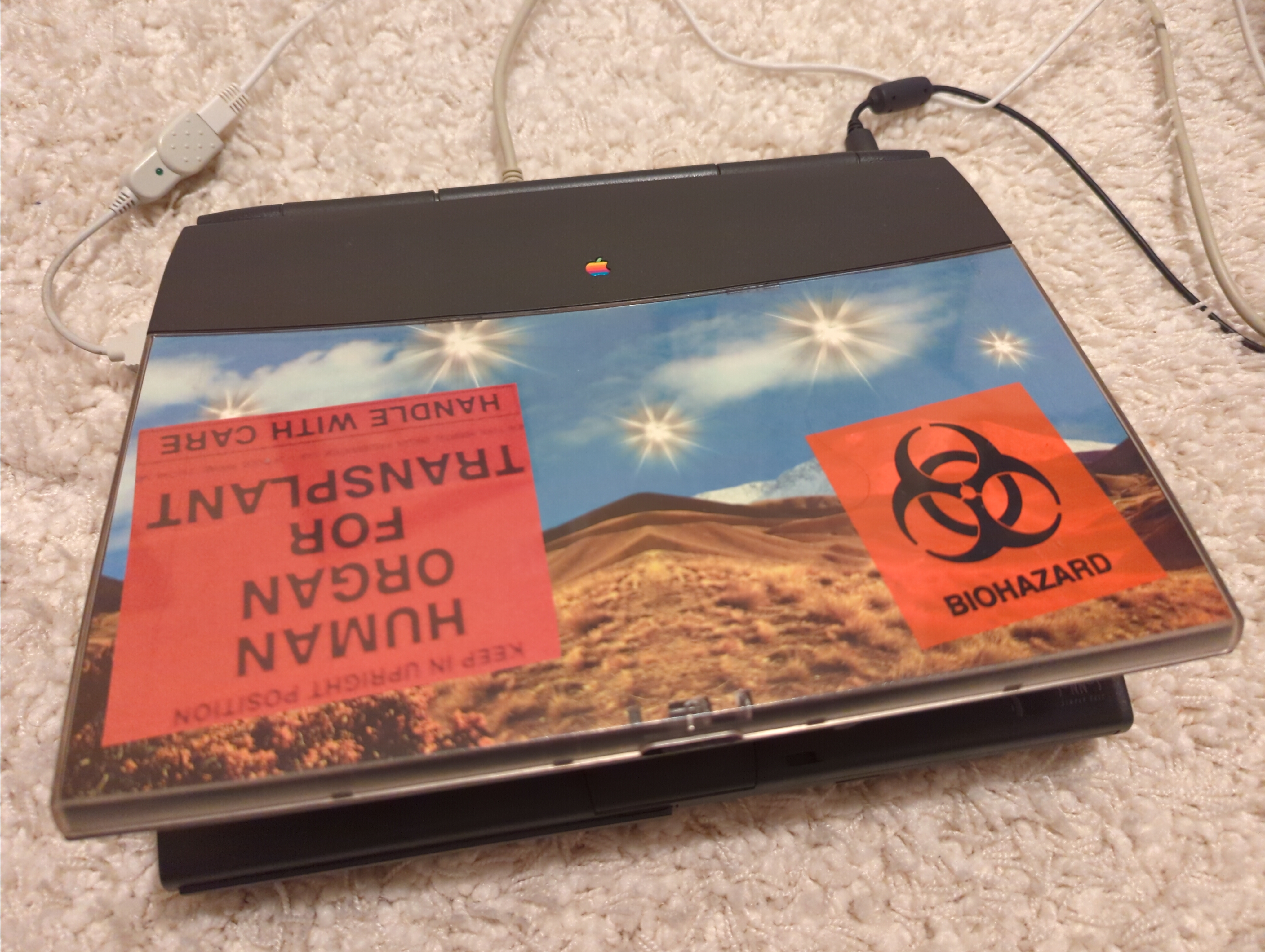
Plus, those delightful swappable covers!

Saturday, September 17, 2022

Refurb weekend: New batteries for the Palm Pilots

Everything portable has a battery, and every portable thing's battery dies. This is bad on earlier PalmOS devices that lack a non-volatile file system because they'll lose their data and you'll lose your mind. Fortunately many of my stable of Palm Pilots and other PalmOS devices use regular old batteries (like my original USRobotics Pilot 1000 and Handspring Visor Deluxe); of my rechargeable units, the AlphaSmart dana has a replaceable battery (I have multiple spares, or you can use regular batteries), and so does the Palm Centro, which has a non-volatile file system to boot. This is another reason why those two are my favourite Palm devices.

Friday, August 5, 2022

The Pong you could program, possibly: the MOS 7600/7601

UPDATE: It is a microcontroller! Read more.

When people think microprocessors that MOS Technology made, they think of the 6502 and its many derivatives, as one should (which are of course frequent topics on this blog too) — but there might have been another one.

In the nethermists of time when polyester ruled the earth, G-d (or at least Al Alcorn) created the Pong machines. These started out as discrete logic that was hard-wired to play the game, both in the original 1972 Pong cabinet and then miniaturized for the Atari 3659 Pong-in-a-chip that was in the first home Pong console (sold through Sears) in 1975. By greatly reducing the component count Atari's new chip made the console cheaper to produce and assemble, significantly aiding mass production. Here at Floodgap orbiting headquarters we have an original Atari Ultra Pong Doubles with the later C010765, referred to as the "ultimate" Pong with 32 game variations for up to four players, and the last and mightiest of the Atari first-party consoles circa 1977. Still, like the original 1972 Pong, it was nevertheless controlled by hardwired logic; ultimately it just played Pong, and that was it. But that's not what this entry is about.

The Pong console wasn't the first home console; that was of course the 1972 Magnavox Odyssey, developed by Ralph Baer as a side project for defense contractor Sanders Associates, and licensed to Magnavox for sale. (For that matter, it wasn't even the first home Pong console: that was arguably the Universal Research Labs Video Action II, which ran ads for Christmas 1974 in an attempt to sell unused inventory made for ailing Pong licensee Allied Leisure and beat most of the others to market in 1975 by a couple of months.) However, it was the first Pong-in-a-chip, something the other fledgling semiconductor companies had yet to duplicate. Texas Instruments was supposed to be developing a single chip implementation for Magnavox's sequel two-game Odyssey 100, but it wasn't ready until later that year for the Odyssey 200, and the 100 ended up with four chips instead despite its simplified games. But that's also not what this entry is about.

The other thing Magnavox had besides their early market advantage was Ralph Baer's patents, and a plausible legal case. Atari themselves capitulated in 1974, determining they lacked the resources to invalidate his patents, and paying a settlement and licensing them instead. Other vendors followed suit. One of these companies was General Instrument, who devised their own black-and-white Pong-in-a-chip called the AY-3-8500, also in 1975. Ralph Baer was aware of its development from the licensing process and had a previous informal relationship with toy company Coleco's president Arnold Greenberg. This exchange was all business: Baer's patents represented a significant source of income to himself and the company he worked for, and if GI could move a lot of chips there'd be a big piece of the action in it. Coleco became GI's first customer and built the AY-3-8500 into the 1976 Coleco Telstar, which went on to sell roughly a million units. The AY-3-8500 was thus firmly established in the market and even Magnavox used it for subsequent Odyssey consoles to the great chagrin of Texas Instruments, including the 1977 Odyssey 3000 which we also have at Floodgap Orbiting HQ. But that's not what this entry is about either.

The AY-3-8500 naturally had its competitors, and Magnavox-Sanders-et amis got a piece of them too, though the design was so cheap and easy to work with that General Instruments crowded most of them out of the market. Besides TI, National Semiconductor introduced the colour MM-57100N, but despite its capabilities was too expensive to dislodge the market leader (and even its graphics advantage was eroded by the AY-3-8515, which was a bolt-on colour encoder for the 8500 and incorporated into later chips). However, there was one company at that time that was very good at making cheap chips cheaply, and it needed money fast. That company was MOS Technology, and finally that's what this entry is about.

Thursday, February 17, 2022

Refurb weekend: Texas Instruments Silent 700 Model 745 teletype

The first terminal I ever used was a teletype. Somehow my buddy when we were in high school got a hold of this weird "printer typewriter" which was none other than one of the famous Texas Instruments Silent 700 series.